Saturday, May 26, 2007

revisiting Damian's bearing

Well Damian was nice enough to send me everything I needed to see how his bearing was built, so that is what I have been up to tonight after restarting the Movement 114 simulation. I switched to the other computer too. The previous one (where it froze) was one I assembled myself. Coincidence?

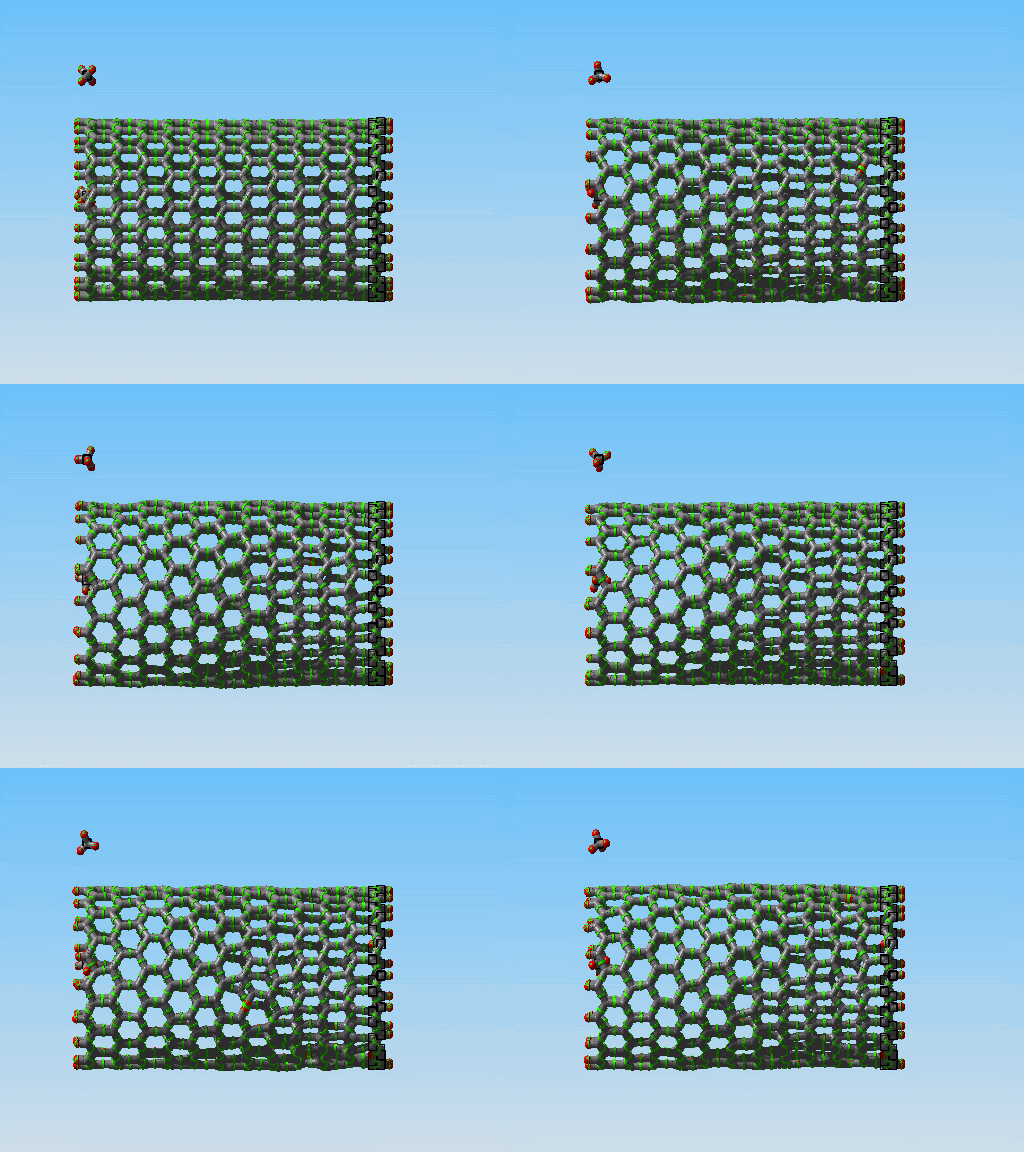
I started with the center section which I carved into a tiny piece that was manageable and could be extruded. By extruded I mean the right hand side will, in essence (I am sure there are more technical ways to explain it), plug into the left hand side. This is a great feature in NE1 that allows you to make very long chains and rings of things very easily.

I next rebuilt this fragment one atom at a time. This took a little over an hour and a few tries because I would lose my place and had to nearly start over. But I eventually got it.

This was the hard part. After this fragment was completed, all I had to do was extrude it into a 16 piece ring and adjust it.

I will work on finishing the complete bearing tomorrow.

another freeze

The simulation froze up again. Bummer. I came home and heard that awful hissing sound; you actually have to unplug the computer to restart it. There is a simulator patch available. Hopefully it will address whatever is causing these freeze ups. I will install it and try again. And just in case anyone is thinking this is some ploy to get out of finishing Movement 114 with saving face, all "he knew it wouldn't work, tried to blame it on the program" and stuff. It's not. I will also try to run the simulation on another computer too, the one I ran the 151 hour cnt srg simulation on.


More to follow...

Friday, May 25, 2007

a couple more outtakes and simulation update

The simulation of Movement 114 is 30% complete after 52 hours. And in the spirit of the last post here are a couple other things that are not exactly frame worthy. The first is rather technical. If that's not your thing, scroll past it for something very embarrassing.

First an honest attempt at measuring the modulus of rigidity of a carbon nanotube. I had intended to post this to see if anyone knows why it went so horribly wrong.


I used this equation for the modulus of rigidity: G = (TL)/(Jθ)

Here T is torque = 500e-9 N-m
L is length of the tube = 24.51e-10 m
J is the polar moment of inertia. Here I used (π /32)[(d1-d2)^4]. d1-d2 would be the thickness of the tube. For this I looked up the covalent radius of carbon (77pm) and multiplied it by two to get the diameter of the carbon atom and subsequently the thickness of the tube.
θ is the amount of twist the torque accomplished. I used a jig to measure this and it came out to 12.3 degrees or 0.21 radians.

When you do this arithmetic you get a ridiculous answer, something like a billion-trillion Gpa.
Anybody see anything I didn't?

And before I decided to totally redesign Movement 114, in a moment of desperation, I was actually considering something like this:


Yes those are carbon nanotube halves bonded to the rack. I sure hope the new design works...

Wednesday, May 23, 2007

simulation update

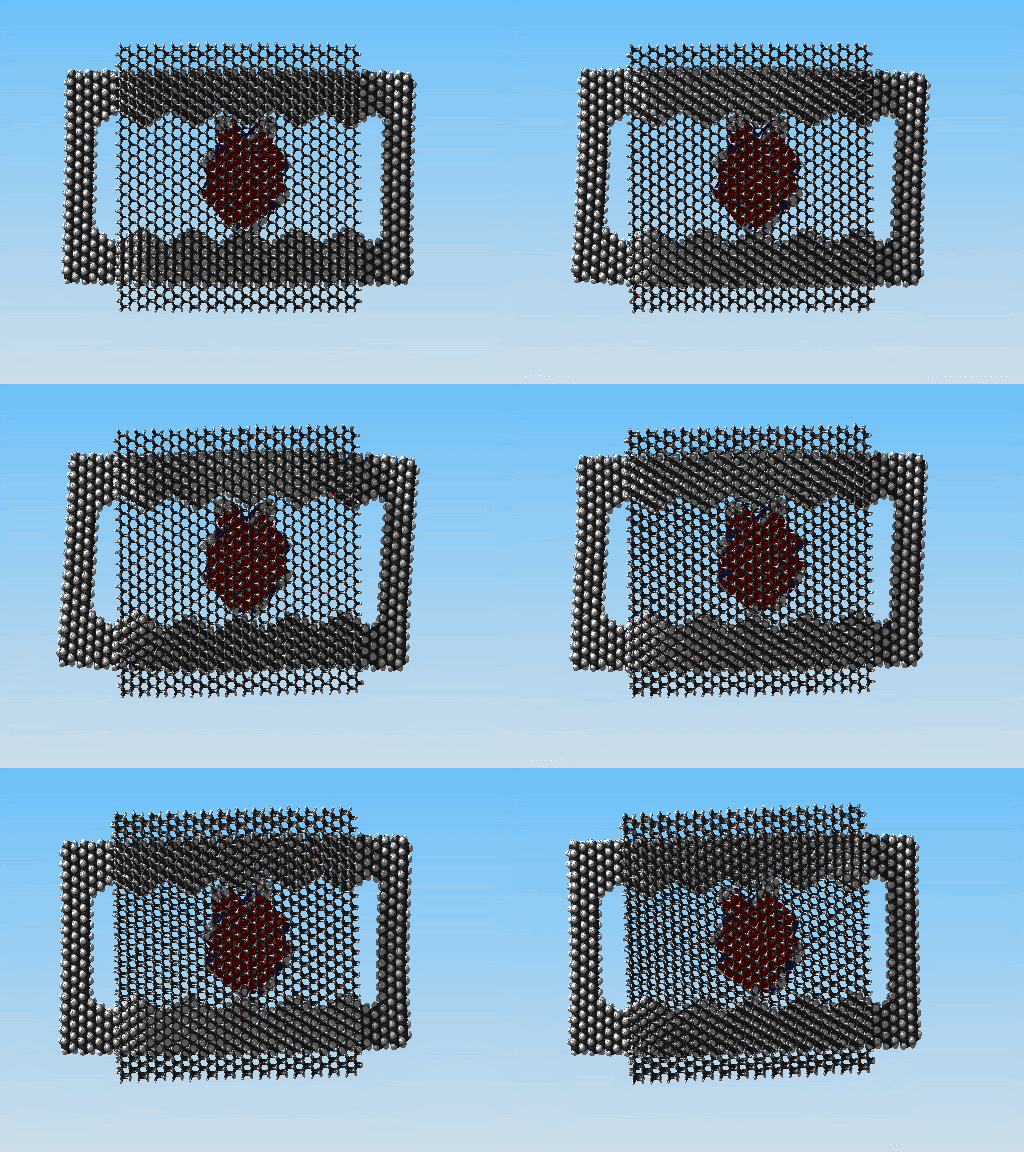
I started the latest simulation of Movement 114 a couple of days ago, but I have ran into some problems. Two near instantaneous power outages and a freeze up (accompanied by an amazing hissing sound from the speakers) have forced me to restart the simulation three times. I can get a back up power supply, but I am not sure what cause the freeze. In the mean time I have been messing around and trying to recreate (loosely) Damian Allis' Low-Friction Carbon Nanotube Bearing Assembly. Mine is still kind of crappy...


Now the excuses:

1. I am using my trusty old Toshiba laptop (perhaps I should approach them regarding an endorsement deal for one of their top of the line models?) and things are painstakingly slow, forcing me to economize on the atom count.

2. I only have the two pictures to work from, and I am having trouble discerning exactly how it's built.

3. I still have a lot to learn and only spent a couple hours working on it.

I had not intended for you to see the wiggly thing on the right. I thought I deleted it, but I just hid it from view while working on other stuff. QuteMol shows all. I could have re-made the pictures without it but thought you deserved to see everything, kind of like how the American space program had a bunch of rockets blow up in full view of the media while the Russians had the benefit of failing in secrecy.

Also Damian's blog has not been accessible today, but if you haven't been there before, keep trying.

Sunday, May 20, 2007

a promising start to the new design


First it looks like my estimation for the simulation was way off, in a good way. This animation was compiled from a 1000 frame/100 steps per frame simulation, and it only took 14 hours. Not bad. The sluggishness I was experiencing during construction did not carry over to the simulation. I believe this makes since because building the part, lots of rotations and view changes, may have taxed my video card and ram, and the speed of the simulation would depend more on the processor. That's my theory anyway. For the record, at a half gig, my computer could stand an upgrade. Also I am using an ATI Radeon 9500 video card, so not top of the line there either.

Maybe my dreams of falling asleep in the penumbra of a processor farm will have to wait, but I am sure I will need it someday, all rack mounted, dozens of twinkling LEDs tapping out messages from the future in pseudo-morse, radiator fins on the roof blazing the IR spectrum like some techno-creature in heat. Yes, someday.

I know this simulation was way too short to see if this design will ultimately work, but for right now I just want to make sure nothing started flying off the thing. Nothing did. You can see that the pinion starts to twist the casing too. Next I will anchor the casing at the corners (just imagine this casing is bonded to some monolithic substrate) and run a long simulation.

More to follow.

Saturday, May 19, 2007

movement 114: new design with casing


I spent most of this evening building the casing. Again I am going with silicon carbide. I also spent a little time extending the pinion teeth by another row of carbon atoms and reshaping the pinion slightly to make it more symmetrical.

Right now I am mainly concerned with two things: the possibility that the rack will shear off hydrogen atoms on the inside of the casing and the monumental size of this new design. There are over 16,000 atoms making this part, and they're giving my pentium 4 all it wants and more. I can't yet imagine how long it will take to create a decently long simulation, probably a couple weeks if I had to guess. Maybe I can put together a cluster of computers, or maybe I can get Movement 114 on the NanoHive queue. I have a hunch the processing problem will need to be solved in order to produce ever more interesting designs.

Friday, May 18, 2007

movement 114: a substantial rework


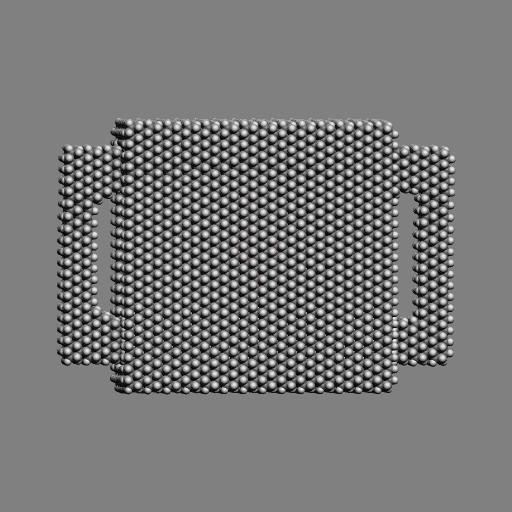
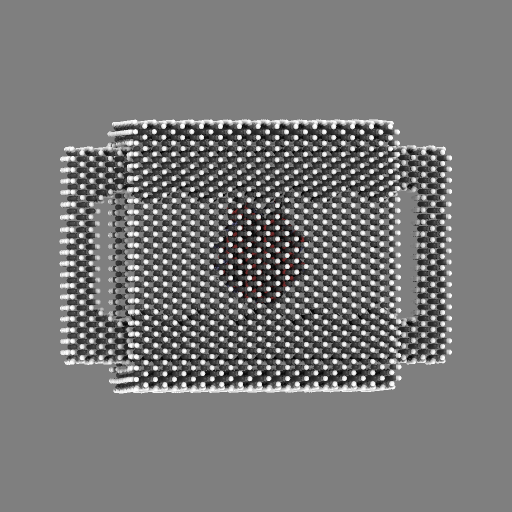
I am throwing out the old design completely. Instead of a diamondoid rack, I have switch to a double layer of silicon carbide. The pinion started off as a gear that is part of the NanoEngineer part library, but I "mutilated" it. It is hard to tell in the top picture, but there should be clearance at the bottom. I am not done though, and if it still needs a little adjustment, I'll do it; silicon is much easier to work with (as I was once told before). I plan on taking my time with this one...

More to follow.