Thursday, August 30, 2007

prelude to the pascaline part 2

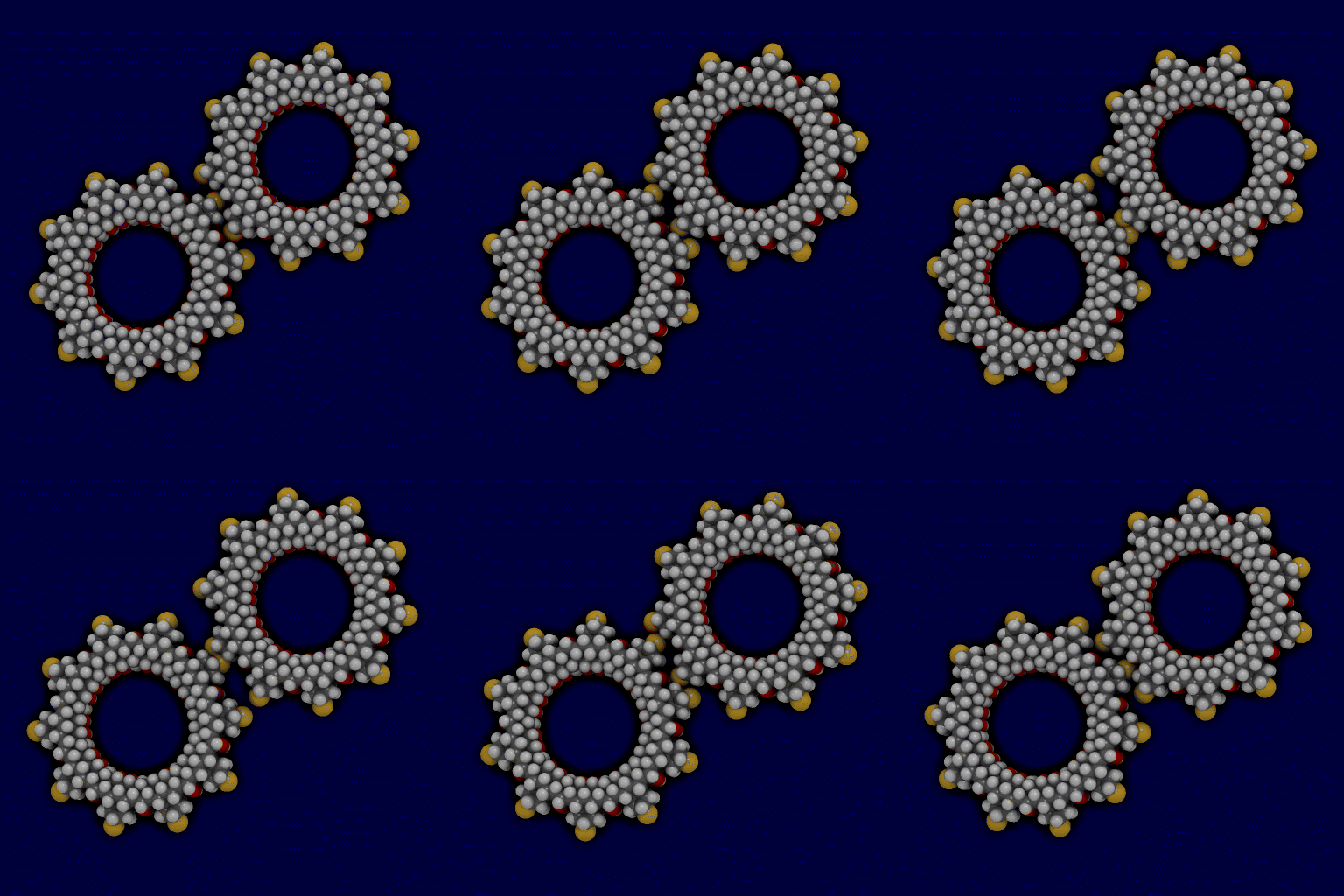
Building and simulating the octet truss has caused me to get over my fear of working with larger parts. I am thinking it might be time to revisit a mechanical calculator in earnest, like actually design one before I start building anything...starting tomorrow. Here is something I am pretty sure I will need: 10 spoke spur gears

So far I like this design because they are robust, and I can trim off spokes to create a "ones" gear. Plus I should be able to attach diamondoid shafts or cnts to the sides. This is a shot in the dark, but does anyone have any engineered drawings of a pascaline?

Wednesday, August 29, 2007

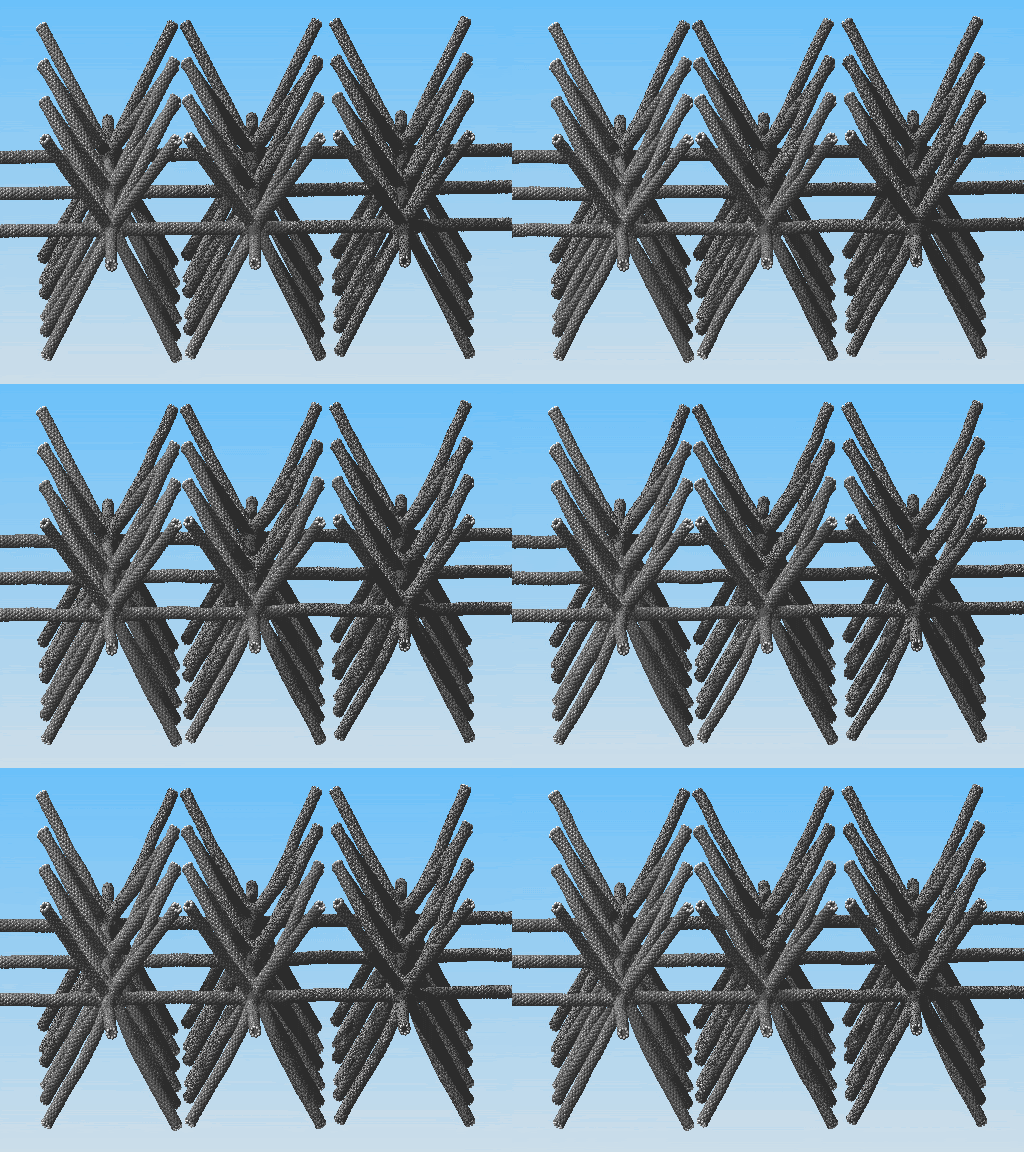
carbon nanotube octet truss simulation -or- it's a ROCK


The simulation was at 300K for 1500 frames at 20 femtoseconds per frame. It has been my experience that if stuff comes apart, it happens before then. Looks pretty solid, as it should I guess.

Sorry, no QuteMol. I tried, but I'll have to wait until I have a day to devote to it. I think the first plug-in for NE1 I write will automate the QuteMol animation process considerably. I could do it now with a Windows app that accepts some parameters and then recreates my very repeatable keyboard and mouse movements (advance frame, save, advance frame, save...), but that's not the point or elegant. If only I had access to some people that knew the ins and outs of the NE1 source code! Wait a minute, I'm getting an idea...

*EDIT: that's 2 femtoseconds per frame not 20

an explanation on how you're seeing the dna

Maybe you are thinking that the DNA strands in the last few pictures doesn't really look like anything but beads on a chain? This is because the DNA strands used to build these cross motifs is being represented in PAM5. This is a convention that uses five groups to represent the major structural components of the DNA strand. I think, and correct me if I'm wrong, but there is a group (bead) to represent a phosphate, each of the two sugars, the nucleotides and the hydrogen bonding on the nucleotides. That's five. That's what I'm going with tonight. It is a hell of a lot easier to work with these groups than the atoms they represent. However I must admit the atomistic representation of the DNA chains is more visually appealing:

The octet sim is done in half the time I thought. It is no wonder I am usually early for appointments. I'll post it later tonight or tomorrow.

MTF

Tuesday, August 28, 2007

CNT - DNA hybrid array in technicolor

The title says it all.

The different colors on the cnts is because they are not b0nded together, merely placed next to each other. I know. I'll bond them. At least this gives you an idea of the scale of things. I am very interested in combining DNA with cnts, so this could turn into something.


The octet truss sim is crunching away on the old sim-computer. I am expecting it to take around 100 hours. It will not be a terribly long simulation.

MTF

Sunday, August 26, 2007

a nanofactory graphic


This was obviously inspired by the nanofactory animation, but I only spent an hour or so on it. I would like to switch out the bar shafts for hexagons and increase the tool tip number. We'll see where this thread goes.

We lost power here, so I had to restart the octet truss simulation. I had to choose between a backup power supply and a backup storage device. I went with the hard drive; what can you do?
I may need to restart it again to save time. Right now I am running it on 1.6 GHz Celeron processor, not my normal simulation computer. After 4 hours it is 0% done. I'll try to swap some things around so we can see how it turns out this year.

Saturday, August 25, 2007

a short DNA primer for the future: sticky ends

This is probably the first of a series of my personal tutorials on building stuff with DNA. I am sure as things get more complicated I will cop out and just link to some fine resources, but for now you're getting my take on things. This may be review for some, but not for others, and I would like to build a one-stop-shop for the information I may use in the future. I did do a couple science fair projects involving DNA in junior high. One included building a model out of dowel rod and window blinds. It rotated. I got an A++ (brag!). The other was an ill fated attempt to mutate Oak trees which I may still revisit one day. Unfortunately due to time constraints, I must assume you did a couple similar projects in school too, so you would know all the DNA- "blue print of life" stuff. Please let me know of any errors.

Let's just dive in...

For building DNA structures we first need to focus on the structure of DNA itself and how strands of DNA join (or won't join) together.

The frame work, or backbone, of a DNA strand is composed of alternating sugar and phosphate groups. I am going to represent these by S and P respectively.

So we have a chain of:
S-P-S-P-S-P-S-P-S

These sugars are the deoxyribose in deoxyribose nucleic acid, and they come in two kinds: 3' and 5' (pronounced 3-prime and 5-prime). The 3 and the 5 represent how many carbon atoms the sugar contains.

A single strand of DNA will have alternating sugar groups and alternating ends:
3'S-P-5'S-P-3'S-P-5'S-P-3'S-P-5'S

But doesn't most DNA come double stranded?
YES, so the groups on a double strand of DNA would look like this:
3'....................................................5'
5'....................................................3'

These strands are connected together by hydrogen bonding of the nucleotides, A, T, C, G

I have developed a somewhat "blue" method for remembering which nucleotides join up. I was inspired by a pin-up art calendar a friend bought me for Christmas years ago: Just remember T and A always go together.

The nucleotides join up at the sugars:
S-P-S-P-S-P-S
A---T--- C---G
T---A---G---C
S-P-S-P-S-P-S
The dashes between nucleotides are just for formatting purposes

Also it is probably important to point out that hydrogen bonds are weak bonds, allowing the DNA to seperate.

If we have a strand of DNA, it is possible to cut it apart using an enzyme called a restriciton endonuclease. These enzymes can cut apart a strand of DNA in a manner that leaves a "sticky end", meaning an end that would happily join to a sticky end of another DNA strand:

3'ACTGCATGACTA------------TCGACTG5'
5'TGACGTA------------CTGATAGCTGAC3'

3'ACTGCATGACTATCGACTG5'
5'TGACGTACTGATAGCTGAC3'

Here the overhanging nucleotides form the sticky end. I used NE1 to create sticky ends on the DNA chains in the cross structure I built last night.

So that was the first DNA tutorial.

MTF
Friday, August 24, 2007

exploring the DNA features of NE1

First for the cnt data storage system, I am trying to produce an image of the electrostatic potential (ESP) of the N and F atoms, just to see what I can see really. However I have not been able to yet, still figuring out how to do it with NanoHive. <- that's a link to the NanoHive gallery. There is an example there of an ESP simulation of a carbon nanotube. This evening I was trying to use NanoHive to make the ESP image. I spent a half hour on it and then fell asleep. I had an amazing dream that I totally figured it out, everything was clear as day; I was even using the program to forecast hurricanes, something I am pretty sure it can't do. Alas it was just a dream... Also I haven't forgotten about the octet truss. I am going to anchor the ends and run a simulation to see if I can get an idea of how rigid it is. Depending on what happens there I may expand the simulation ambitions.

Other than just playing around, I have not done anything with the DNA modules of NE1, until tonight. Here is a DNA cross motif I built following a tutorial...more or less:
This image was rendered in QuteMol and is of DNA chains connected together to form a cross.

These arrays have actually been synthesized, so we are more into science fact than fiction. I'm just getting into myself, but I understand DNA nanostructures have big time potential.

Definitely MTF