Tuesday, July 31, 2007

breaking 100k on the truss with some planks


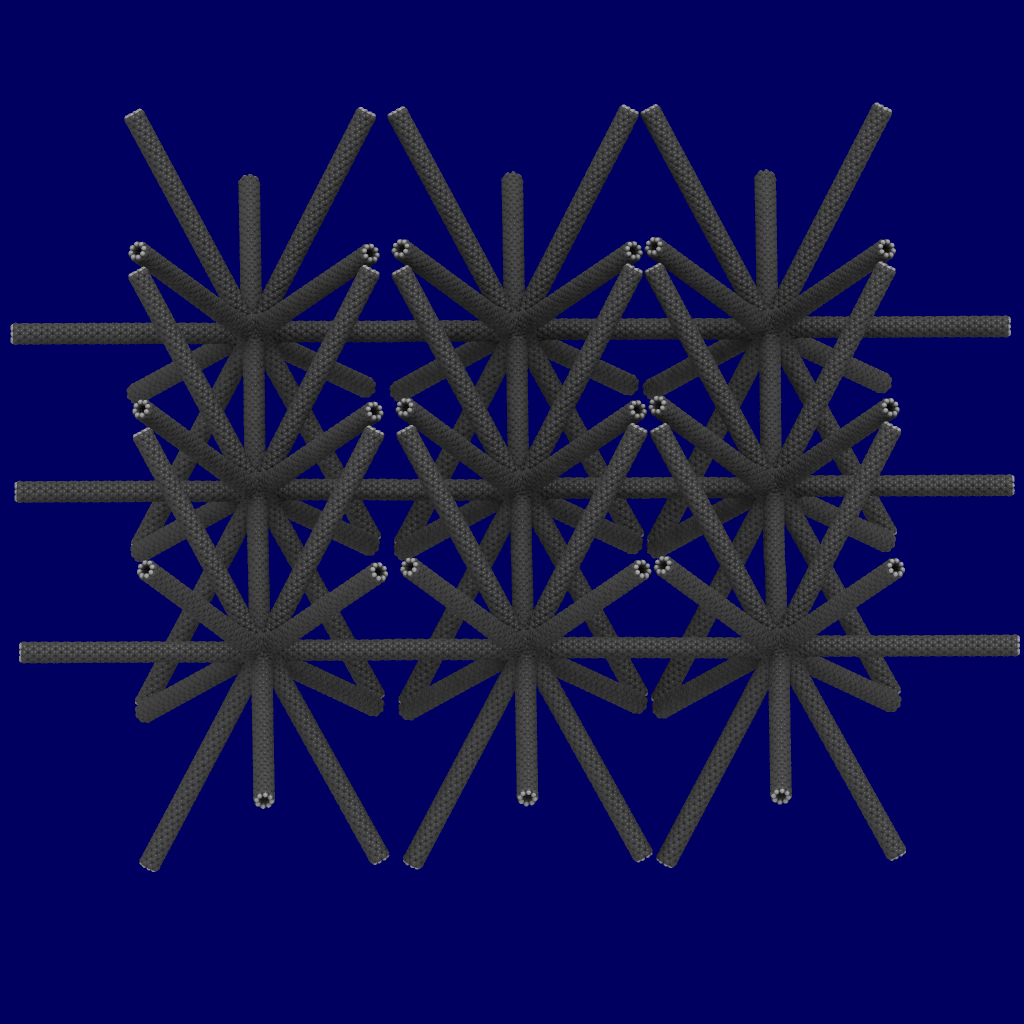
Remember when I used to whine about 15,000 atoms? Well, I'm past that. Placing these four diamond planks over the truss has brought the atom count up to 121,812. Not all the planks are completely bonded to the truss yet, but I wanted to see if it would be possible for my system to work with a part this large. It takes a lot of patience, but it's not impossible.

I wanted to get a QuteMol graphic, but there is some combination of A8 and QuteMol that doesn't like larger files. Tubes get dropped and crust gets formed. I still haven't tried saving a large protein data bank file in the A9 version.

I don't really think this is a practical way to simulate the truss under stress. I would have to attach dozens (hundreds?) of linear motors to individual carbon atoms on the slabs which would then transmit some of the force to the truss, but I think it looks pretty cool.

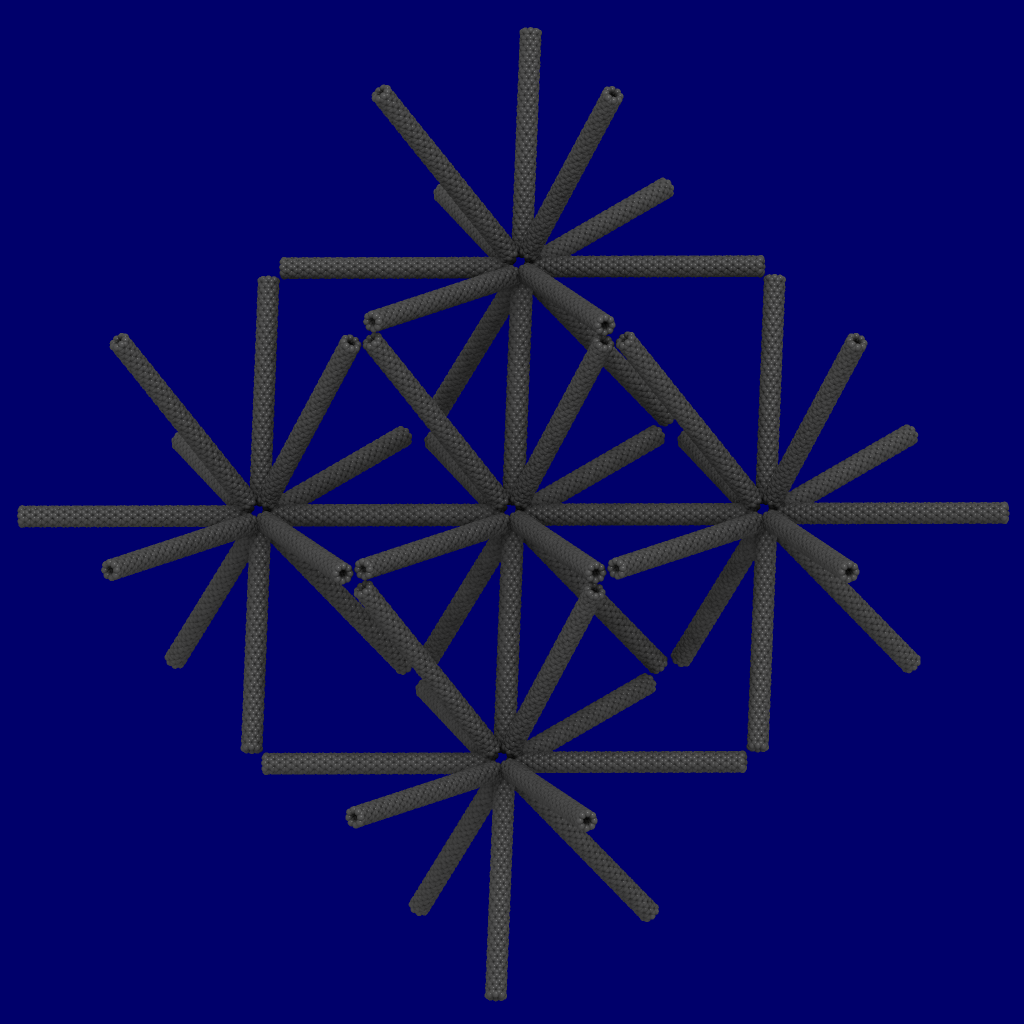
the bonded carbon nanotube octet truss


The atom count for this truss came to 63,900. I am going to leave the remaining junctions un-bonded until I decide if/how I will simulate it. I may want to use them to bond to a diamond slab or something. However capping those would, after all this, be trivial.

putting the truss together


Here is how I am putting the truss together. First I cut each spoke in half and seperate each one into two chunks. Then when I want to bond two hubs together I delete the front chunks of the connecting spokes and bond the back chunks together. In the above picture you can see the back chunk highlighted.

Bonding the spokes:


After adjusting them:

I will repeat this process to build the truss.

If it turns out good, I will say something like "I knew it all along". If for some unforeseen reason it doesn't, then I will say "I wish I had an octet truss to hold up my heart right now".

MTF

Monday, July 30, 2007

water saved me


So everything is bonded together at the hub. It went much faster during this session, thanks a lot to the water function. Turning on this view places a semi-transparent filter across the part. The depth of the water (its position relative to the viewer) is adjustable, and only atoms above the surface are "pickable". When I first started I was rather overwhelmed with all the open carbon atoms. Atoms that looked next to each other would actually be across the hub.

First I tried hiding tubes not in the immediate area I was working on, but I really need the whole picture all the time. Then I tried displaying different tubes in CPK view (This is the solid view that the previous two pictures use. Now I believe it stands for Corey, Pauling and Koltun and not California Pizza Kitchen. Trust me; you don't want to make that mistake at a cocktail party with a bunch of chemists <- and NEVER leave your cocktail unattended*), but this view still obscured too much. Finally I switched to water, and all was clear.

Now I will focus on clean up. I find it is easier to "rough in" the lattice. By this I mean I try to close as many rings as possible with either hexagons or pentagons, but at this point I don't sweat larger rings, and there are a couple doozies in there. But it is pretty easy to focus on one of these at a time and break them up into smaller, more regular, rings.

Also this part is still unadjusted. By that I mean I have not yet had NE1 adjust the atoms and bonds to a geometry fitting with the molecular mechanics module. I would adjust a few atoms here and there as I was working, but not the whole hub. Don't worry. I am in no way expecting this to distort all my hard work; it has been my experience that this will only tighten things up more.

MTF

* my apologies to any chemists that may take offense to that advice.

Sunday, July 29, 2007

working on the hub

I spent some time to day bonding the spokes together at the hub for the truss. It is slow going, but I am roughly a third of way through. Here is the side I have finished:

Here is most of what's left:

I will chip away at it over the next couple of days.

The C60 pump simulation is at 52% after 188 hours.

Friday, July 27, 2007

getting real close now


A little adjustment here and there and I think it will be good. Then all I have to do is bond the 12 spokes together without having them move.

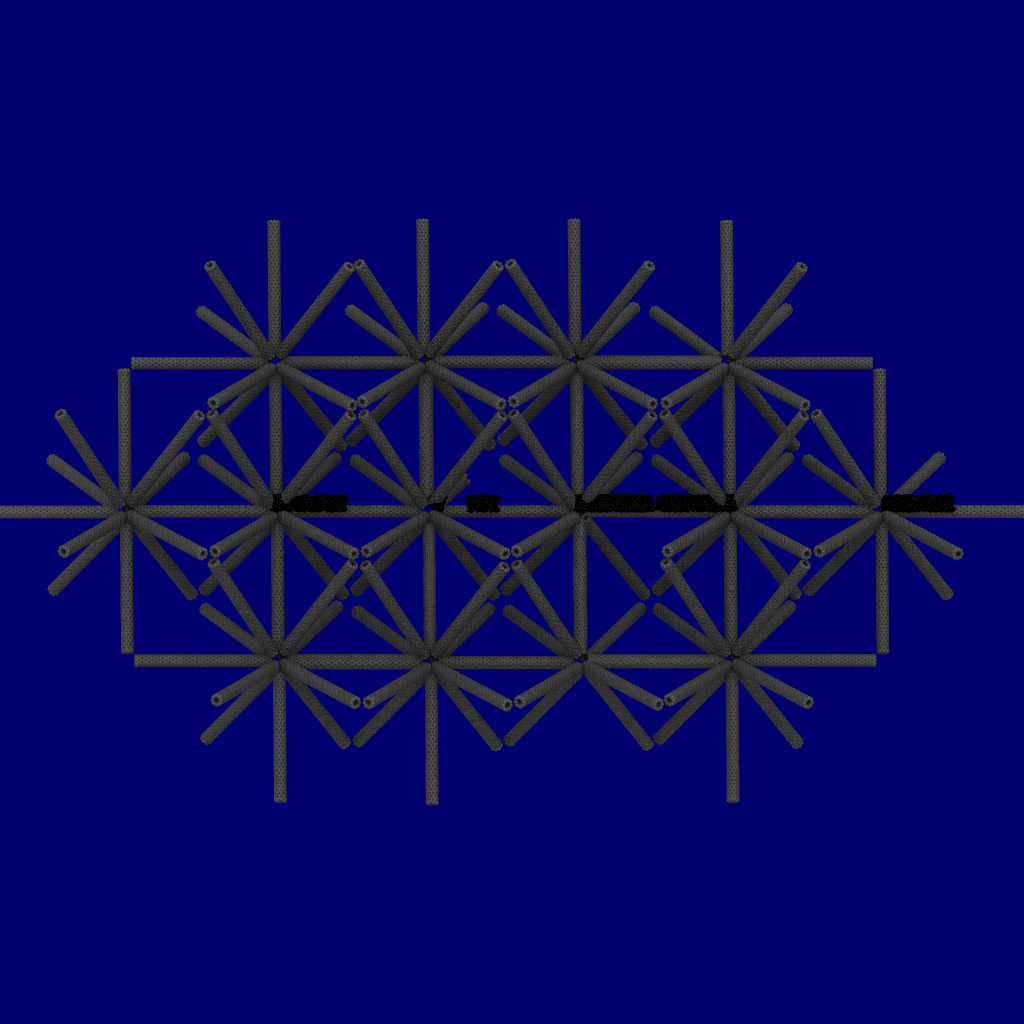
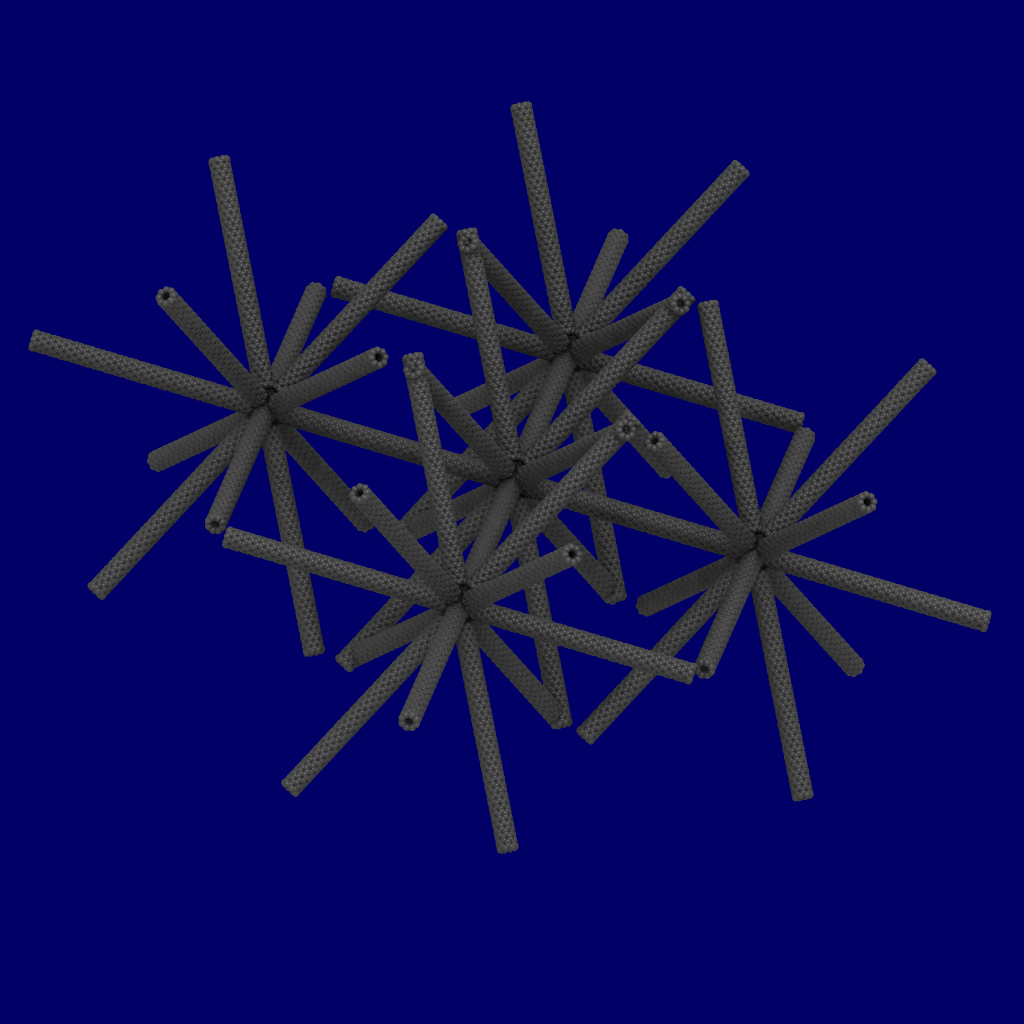
Also while I am a little too wiped out to start bonding the spokes tonight, I am not too tired to drop a bunch of hubs in to make a large truss, just for looking at. When I did and opened the file in Qutemol to get a good graphic, I got this:

There are some missing tubes and that weird atomic crust on the others. I don't know if that is from Qutemol or if there were problems with saving the protein data bank file. I will try saving it again in alpha 9 and see what happens.

MTF

getting closer on the truss


I am using a different approach now. I won't bond the spokes together at the hub until I know they will line up, again probably one of those hindsight is 20/20 things. You can see that some tubes still need a little more adjusting, but since they are still loose, it's pretty straightforward. I actually hold a protractor up to the screen.

BTW, this is the right configuration isn't it? I have never actually seen one of these things, and Jim's comment was the first time I actually read the word "octet truss"( even though I did read a bio on Buckminster Fuller years ago and some of his poetry [his poetry sucks]), and this is the best reference I currently have.

Also anyone have any ideas on how to test this thing in the simulator? I could just let it sit there and see if it stays together and doesn't wobble a whole lot. What would be great is if it could be put under some stresses, like try to crush it between two diamond slabs. I just don't if I have the computing resources to pull that off though. We'll see.

MTF