Friday, September 21, 2007

more DNA structures and arrays


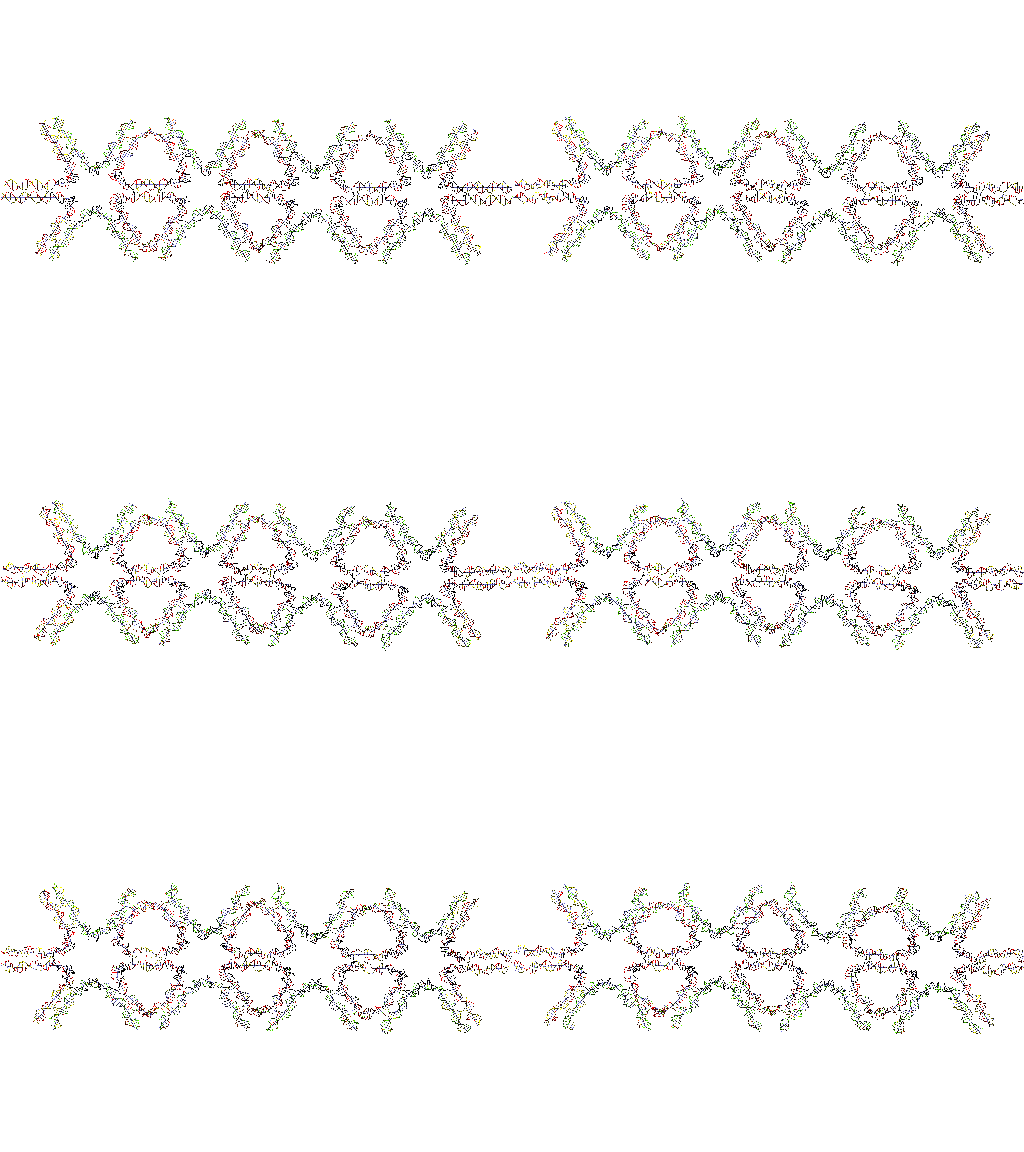
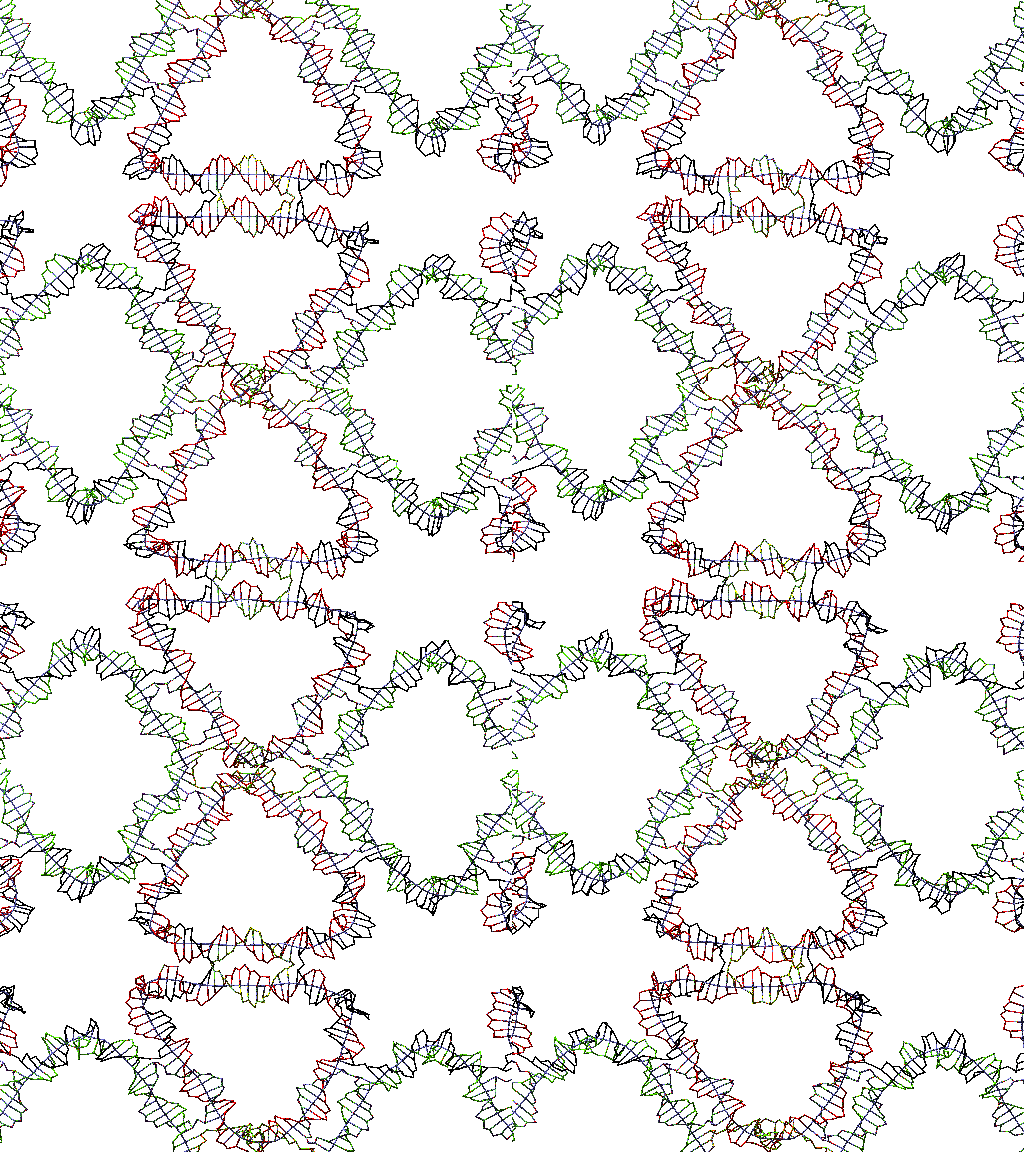
The three-point array in CPK veiw

The six star in CPK

A cube. This has been synthesized in the lab.

Carbon nanotubes covalently bonded to the cube. I don't think this has been built yet.

DNA octahedron. This has been synthesized too, link to article abstract.

Full write ups and tutorials on construction in process.

MTF

Thursday, September 20, 2007

a six star DNA array


I am going to try for some 3D structures next.

MTF

Wednesday, September 19, 2007

big DNA post as a make up -or- a three star array

All right I know it isn't an analytical engine, but it's interesting none the less. I have been spending a lot of time catching up on the state of the art in DNA nanotechnology. I have to say I am now a convert. I believe it will be a major enabling technology. Here is a piecewise example. Everything was done in NanoEngineer-1 Alpha 9.

First I inserted two DNA duplexes with 30 base pairs each. Here I am using the reduced PAM-5 model to represent them, but these are more or less the same things you have in your cells.


I positioned them over each other and lined up some phosphate groups on the back bone (displayed in purple).

Next I selected four phosphate groups and made what's called a cross over. You can do this manually or with just a click:

This is not just a trick of the software. There is a well established "wet" process to do this in the lab, or maybe kitchen depending on how you roll. Now the strands have been connected. Here is a color coded picture to show the new connections:

This arrangement is referred to as a Double Anti-Parallel Even Crossover (DAEX). This is the starting point for a lot of larger DNA motifs. Enzymes can be used to create sticky ends and bond the strands together. By dropping in a few more of these, a little arranging and bonding, and you can start to build up arrays like this:

Here I have changed the colors and display mode a little, but you can still make out the different chains.

This array has been synthesized in the lab. What is great about DNA is you can arrange a lot of atoms precisely and quickly. These arrays have been proposed as scaffolding for more complicated structures. Maybe something like this could happen (now I think I am getting speculative).

Here I have attached a thymine molecule to a cnt, just as a quick example.

However by creating additional sticky ends or nucleotide overhangs, you can use these arrays to precisely position other molecules. Maybe this specific example would not work, but you can get the just of the idea. That idea being if I drop a bunch of these thymine doped tubes into solution, they would attach themselves at predetermined positions on the array. Actually I think it would take more than the thymine-adenine hydrogen bond, but there are other ways to attach things, and the tube looks too cool to delete.

MTF

Friday, September 14, 2007

might need to extend the gears


I have started to build some casing parts I can throw in to hold the shafts. Here is a close up of the shafts in their bushings. The spacing puts the gear teeth a little farther apart than I had hoped for.

Some interesting ESP images of the cnt data storage system


First I would like to thank Brian Helfrich at Nanorex for producing these images.

EDIT: the second picture shows the actual atoms that were involved in the calculation. And the fluorines are in yellow, not red. The red-looking atoms are carbons being colored by the red haze in front of them. --My fault

Second- we are not entirely sure what is going on because red represents an area of large positive potential, blue negative. The square shows what atoms were included in the calcs. Here the fluorine atoms are being displayed in red and the nitrogen atom in blue. OR maybe that explains why fluorine is so electron-hungry: the large positive potential helps attract electrons from other atoms? Don't worry. There is additional personnel at Nanorex that should be able to explain what's going on, and I will ask him about the second week of next month. (<-Inside joke--brag!)

Also I know not too long ago I made a bold statement of "keep up the pace" in spite of everything else going on. I would like to point out that I also said I was going to make a huge-ass orrery too, and that hasn't happened. In all fairness to me, the orrery was more of a hardware constraint than a time one.

I got a big old test Monday, but I guess I could cancel a couple dates this weekend (models are a dime a dozen right?). We'll see how it goes.

Monday, September 10, 2007

turning the diamondoid 10 gears into shaft


This shaft is the length of five of the single gears, and comes to a just under 4,500 atoms.

Sunday, September 9, 2007

counter rotating diamonoid spur gears


The torque is set to 20nN-nm, and the gears just slip past each other.