Wednesday, June 6, 2007

some more work on Ferguson's orrery

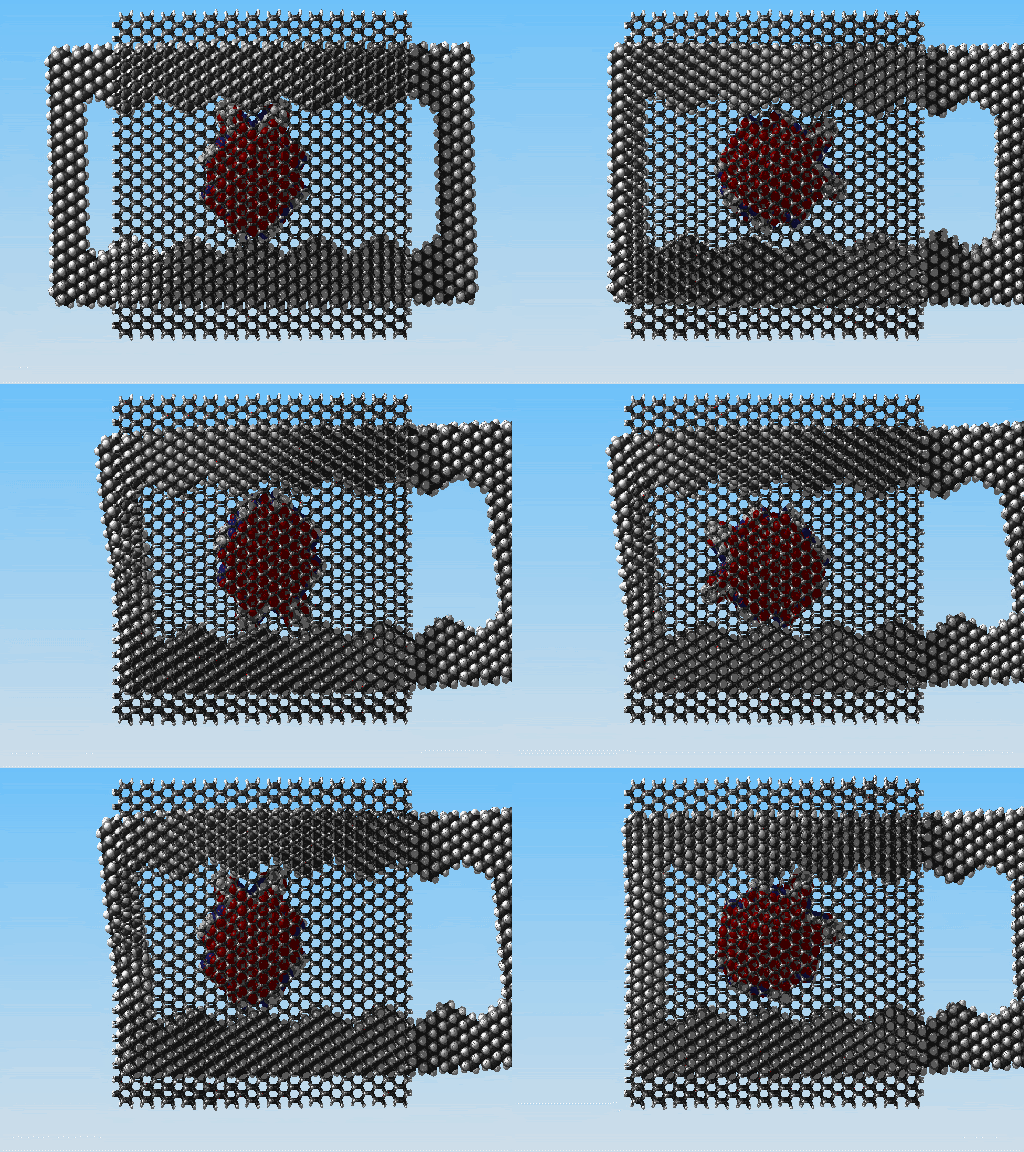
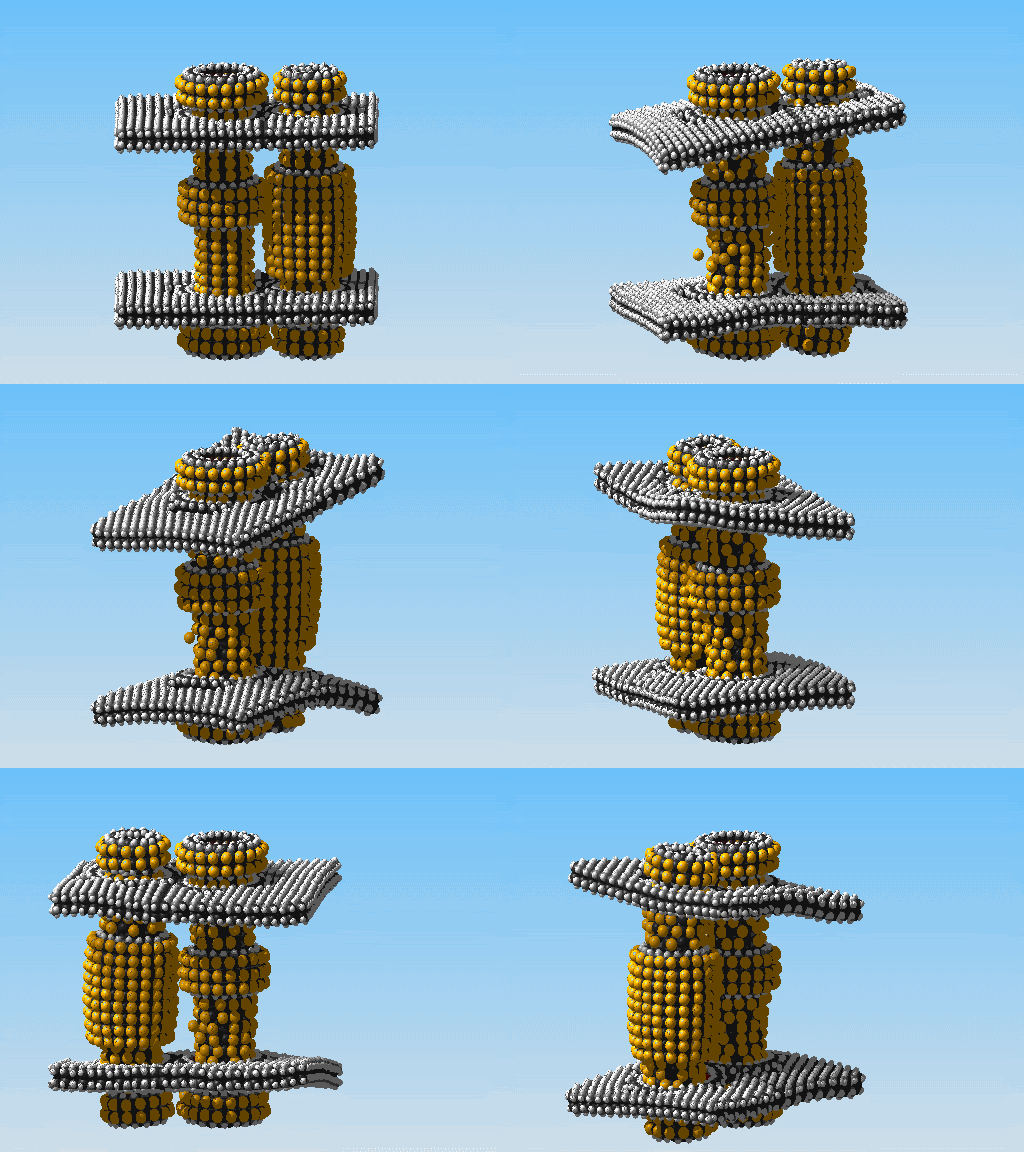
This is an animation of the first A-B wheel simulation. I was not expecting the wheels to lose their integrity the way they did. You can see they initially bow out.

I believe this was because they were placed too close together. Initially I was worried about them being spaced too far apart which lead to the awful looking seam in the casing as I kept removing SiC layers to get them closer.

In the first simulation the point of closest approach is .94A. I decided to rebuild the casing to separate the wheels a little more, to 2.26A.

I also added a full left wall to the casing, and I am working on adding two front struts as well.


This is the new casing with the left wall and one of the front struts. I have also shortened the wheels a little too to make them less flexible.

I am really starting to hit a performance wall with my computer. It takes 15-20 seconds just to bond two atoms together, a step that would be near instantaneous with a low atom-count part. I am not sure if I can finish this project with out first upgrading some hardware.

For about $300 I can buy an ATI X1950 Pro video card and another half gig of ram, or I can put all my hope in an impulsive email sent god only knows where, someplace in the Toshiba Corporation, to god only knows who but definitely someone four or five levels down the hierarchy from someone that can make those decisions.

Hmmmm...

Sunday, June 3, 2007

wrapping up Movement 114, for now anyway


I know I said I was going to make a hi-def animation, but decided not to. The movement starts off great, but then kind of craps out. The pinion just can't push the rack back and slips past instead. I am moving on to Ferguson's orrery, but may revisit Movement 114 in the future. My ability to build different pinions, like a full diamondoid one, is expanding, and perhaps in the future I'll build the kind it would take to make this work.

The full simulation of a 16,000+ atom part at 8000 frames/100 steps took just over 180 hours on an average off the shelf computer.

Friday, June 1, 2007

more on Ferguson's mechanical paradox today


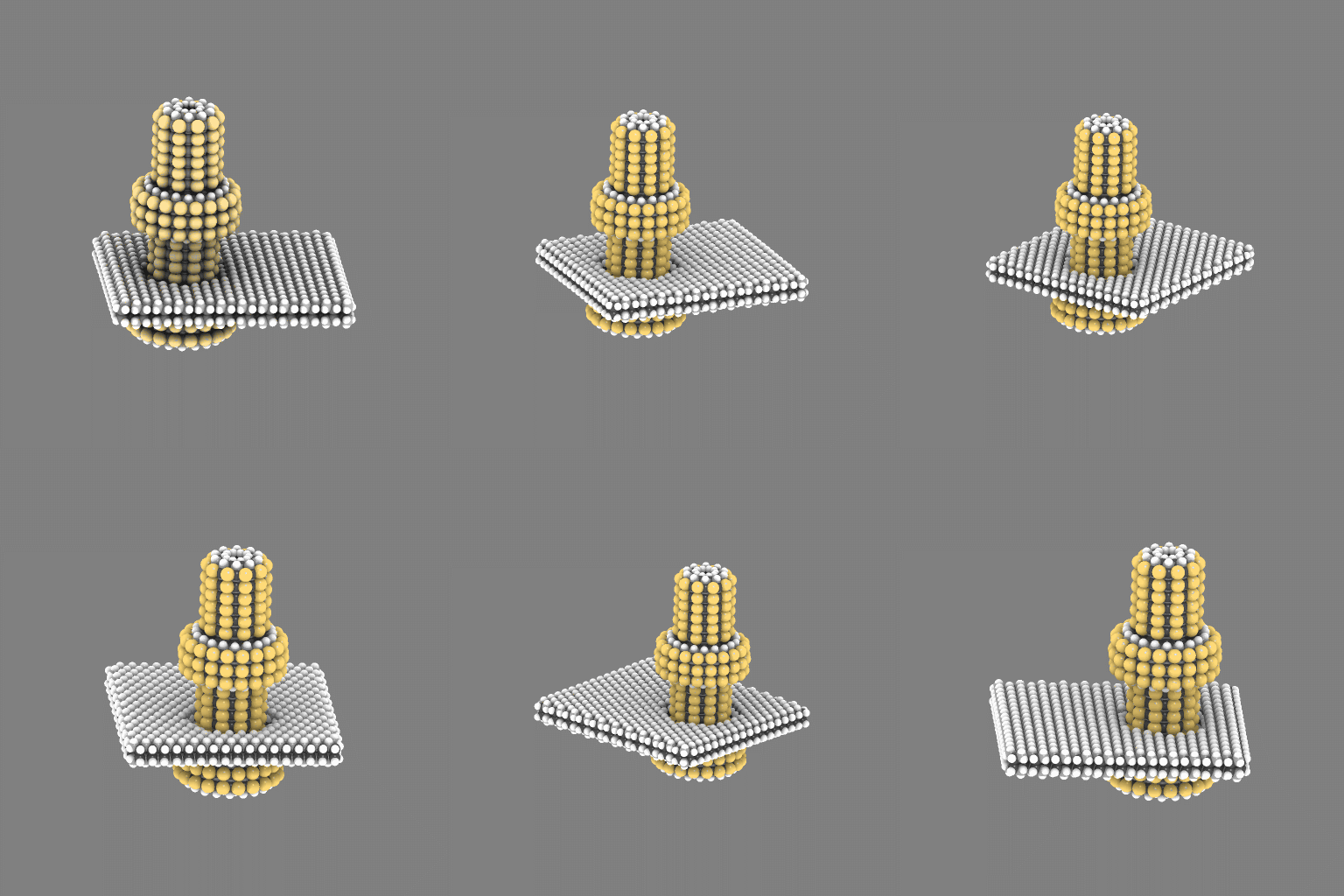
Instead of just chopping a hole through the silicon carbide slab, I backed up a step and inserted some bushings. They might be a tad bit tight, but I ran a quick simulation of the "A-wheel" turning through them and everything held. I also worked on the "thick B-wheel". Next I will add the other two spacer rings on each of the pinions and run another simulation, but not tonight; I need to run out and buy some Visine.

The atom count is over 8,300.

More to follow.

the start of Ferguson's mechanical paradox


I built this this morning. It is the stationary stud and the fixed "A-wheel" around which the rest of the orrery rotates. Imagine the silicon slab extended outward with a pinion, "M" and "thick wheel B", meshing with the sulfur atoms on this shaft. A little farther out on the slab will be wheels E, F, and G. I am still not sure how I will build three independent gears on the same axis, but I have a can-do attitude. I know I should be thinking really hard about that, but I can't stop the images of a complete orrery with buckyball planets from flashing through my mind.

The atom count has already exceeded 3,500.

Wednesday, May 30, 2007

Movement 504 -or- Ferguson's mechanical paradox

So the simulation of Movement 114 is only a little over half done, and I am thinking about what's next.

"designed to show a curious property of the epicyclic train. The Wheel, A, is fixed upon a stationary stud about which the arm, C,D, revolves. In this are are two pinions, M, N, upon which is fitted loosely a thick wheel, B, gearing with A, and upon the other are three loose wheels, E, F, G, all geared with B. When the arm, C, D, is turned round the the stud, motion is given to the three wheels, E, F, G, on their common axis, viz. the pin N; the three forming with the intermediate wheel, B, and the wheel, A, the distinct epicyclic trains. Suppose A to have twenty teeth, F twenty, E twenty-one, and G nineteen; as the arm, C, D, is turned around, F will appear not to turn on its axis, as any point in its circumference will always point in one direction, while E will appear to turn slowly in one and G in the other direction, which -an apparent paradox- gave rise to the name of the apparatus."

Still confused? Try here.

Wish me luck.

Monday, May 28, 2007

the finished Low Friction Carbon Nanotube Bearing... more or less


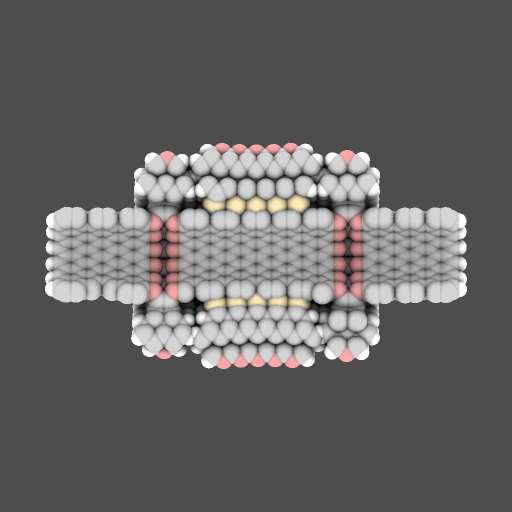
I finished the bearing tonight except mine looks a little pinched. I will have to extend the center tube slightly to ever use it, but that's no big deal. For tonight it looks like I am turning my back, slightly, on being a vastly patient professional. I am shamed.

Damian has posted a very interesting tutorial regarding this bearing on his blog. He says more, and in a better way, than I could. If you are interested in nanostructures, and since your reading this it is a safe bet you are, I recommend checking it out.

Also, basically for the hell of it, I sent an email to Toshiba regarding a sponsorship. The good news is they haven't said no yet.

The Movement 114 simulation should be completed in a couple days. Regardless of how it turns out, I plan on making a very pretty animation with QuteMol of it.

More to follow.

Sunday, May 27, 2007

progress on the Low-Friction Carbon Nanotube Bearing Assembly


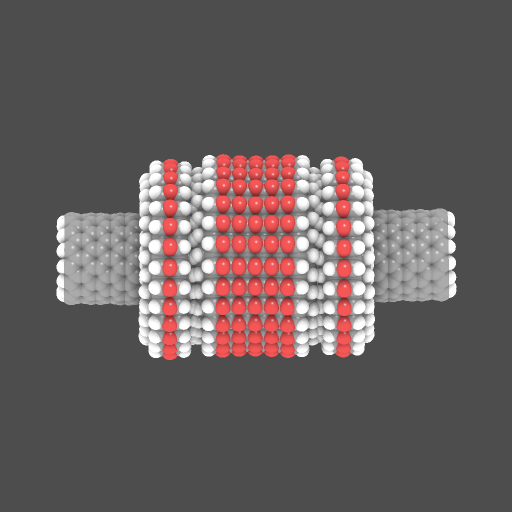
This was all I managed to complete tonight. I started off the same way, cutting a small piece from Damian's original ring and rebuilding it. I found out that in order for this to work perfectly I needed to deduce the original moiety or else my ring would not be the right size after I extruded it. In hindsight this is pretty obvious. Moiety is a term from chemistry I never encountered in my two semesters, but now I think of it as the unit cell of a crystalline lattice. In this case, the smallest repeating unit of the ring.

Since this ring needs to attach to a carbon nanotube of a specific size, I could tell right away when I was off on the fragment. It took a couple hours, and a serious case of wah-eye*, to find the right piece I needed to rebuild the ring. There was nothing too elegant in this, pretty much trial and error.

I also made the same mistake in the large ring I posted last night, making it way too large. I'll have to fix that too. Lessons learned and all.

Also, I still can't decide which format of picture I like best in QuteMol, so that is why I keep mixing up the graphics standards.

Movement 114 is crunching away on the other computer. I am not expecting anymore freeze ups. I remembered late last night that the other computer did the same thing once while playing Doom 3, so it is something idiosyncratic to that computer.

*wah-eye is a term left over from video games, short for watery eyes from intense monitor looking.