Thursday, May 17, 2007

too true, Mr. Pynchon... too true


"The illustrations were woodcuts, executed with that crude haste to see the finished product that marks the amateur. True pornography is given to us by vastly patient professionals."

The Crying of Lot 49 -Thomas Pynchon

Wednesday, May 16, 2007

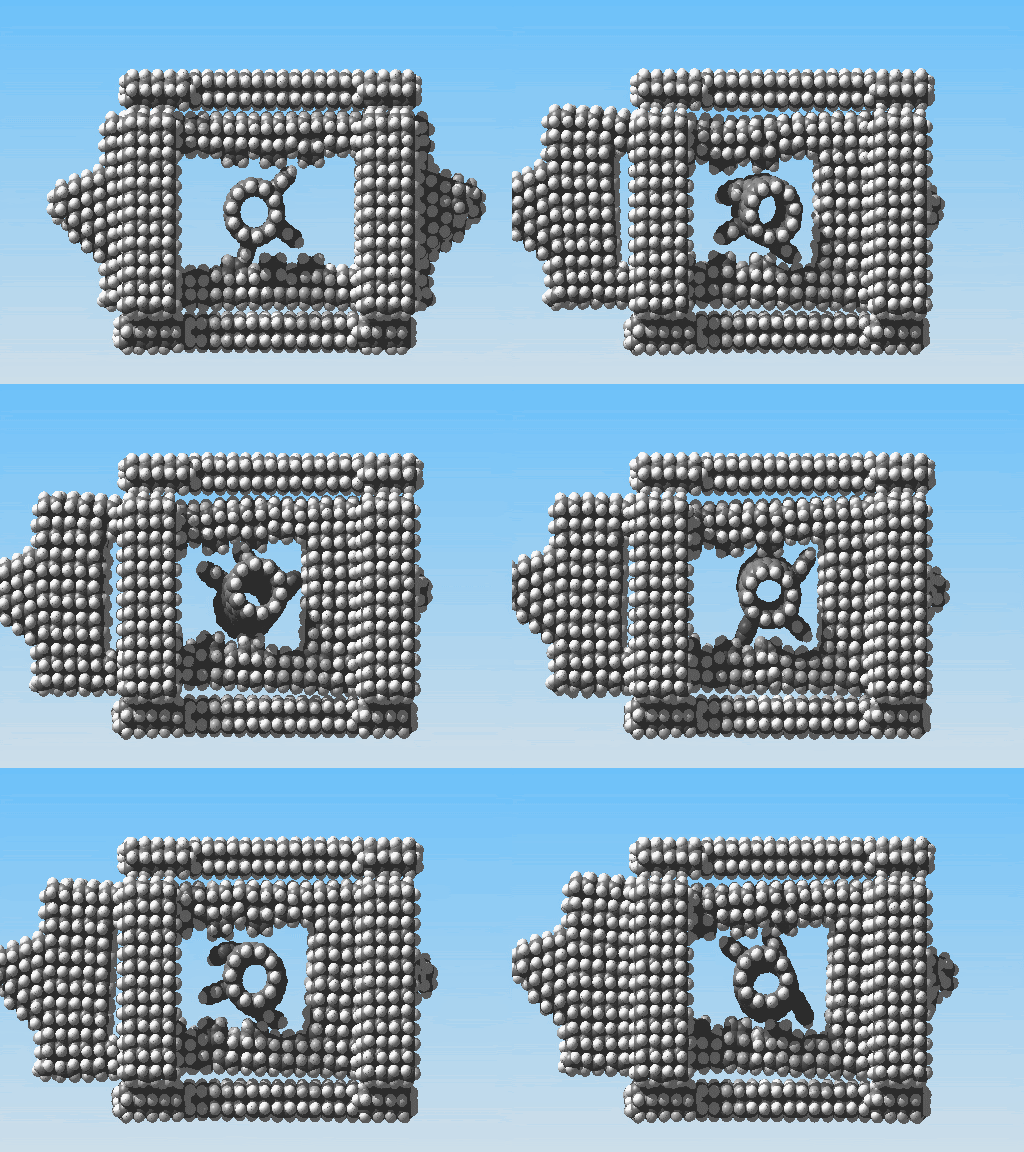
more with QuteMol: an animation


I am still waiting for my other simulation to finish (76%), so I thought I would try to create some animations using QuteMol. It was not straight forward; I even tried to use a special-help from the Nanorex crew, but I figured out a way to do it before any of them responded, so I still have the satisfaction of doing it myself. Here it is in all its mouse-hand cramping glory:

1. run a simulation
2. advance the simulation a few frames (for this one I used 40 instead of 20)
3. save the part as a .pdb file
4. use QuteMol to make it look nice
5. save it as a .png file
6. repeat for all the frames used in the animation (this one has 33)
7. animate the frames using an animation program (I used Movies13)

I am starting to worry that this blog might take too long to load with all the gifs. It already does on my Toshiba laptop. I might have to start taking into account the file sizes too.

Also you might notice that the clutch in the simulation is reversed. The default view in QuteMol is NanoEngineer's rear view.

Tuesday, May 15, 2007

new graphics software...


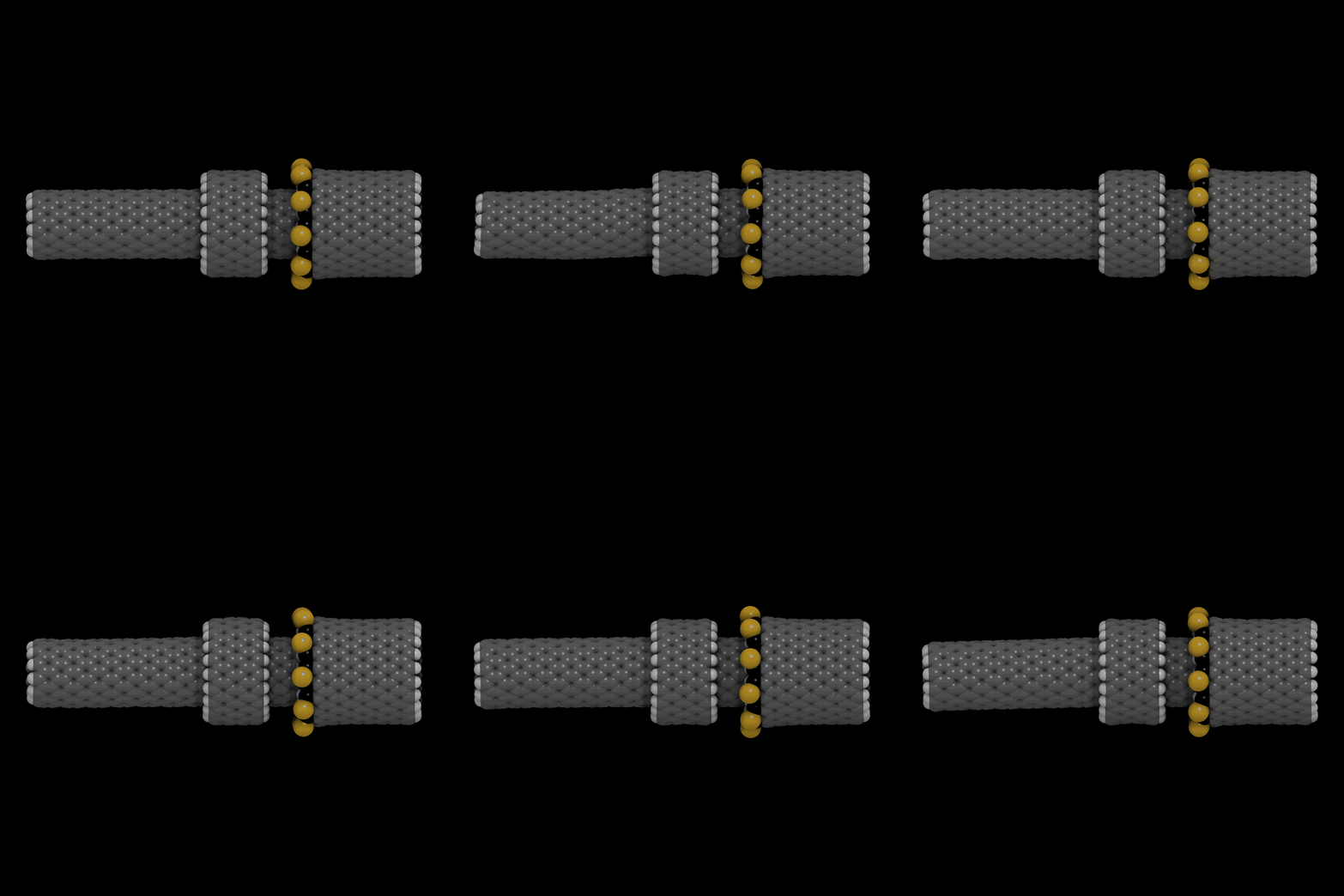
These pictures were rendered with QuteMol. This is a rendition of Movement 114 with the cnt bushing (the simulation is still crunching away) and the cnt srg. When I was building the cnt srg, I didn't realize the casing plates were so misaligned. They are bonded together to create a single-piece casing, but in Hi-Def you can see the middle plates are a little crooked.

continuing the detour - finding Young's modulus of a carbon nanotube along the long axis


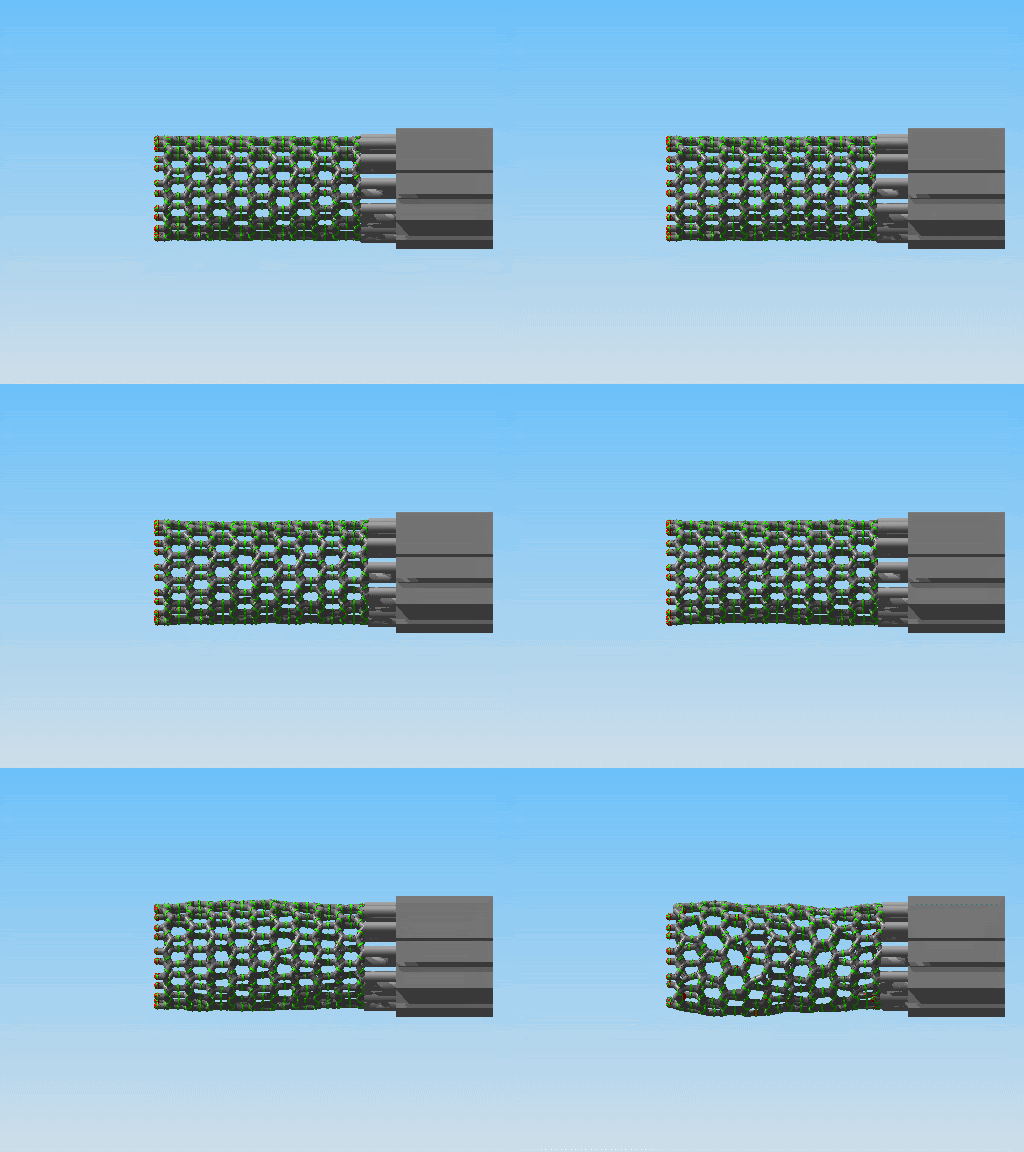
While I am waiting for the latest simulation of Movement 114 to complete, I thought I would try another experiment. This time I am trying to find Young's modulus, or the modulus of elasticity, of a carbon nanotube positioned as shown. This tube is 20A long and 9A in diameter. Just like before it is being subjected to 1000pN of force. Here is the elongation/time plot:


Again you can see that eventually the tube starts to break up just like in the last experiment. Before it does it makes an average elongation of .38A. I have calculated the stress applied as 1.59e9 N/m^2 and strain as .02. This gives a Young's modulus of 75 GPa and a spring constant of 24.1 N/m.

I believe that the generally accepted value for the Young's modulus of a single wall carbon nanotube is approximately 1000 GPa, so I am off by more than an order of magnitude with this one. However I am not sure of the physical properties of the tubes used in these other experiments, and I do believe the Young's modulus of single wall nanotubes is heavily dependent on its size and chirality. Hopefully I can find these others experiments and find out exactly what type of tubes were used.

Sunday, May 13, 2007

science detour - the carbon nanotube as a Hookean spring


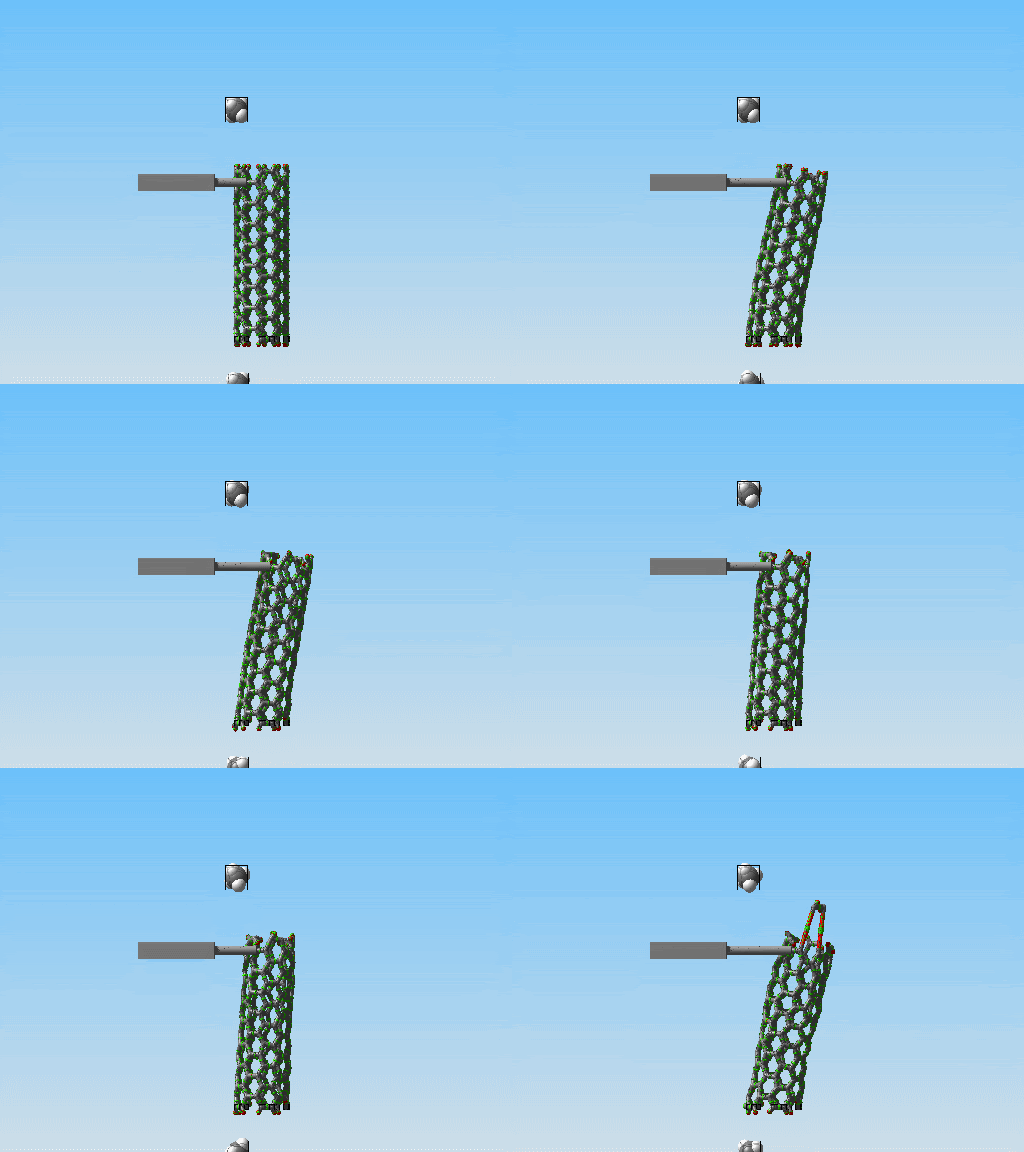
Here is an experiment to get an approximation of the spring constant for a nanotube positioned as shown. The tube is 20A long and is being subjected to a constant force of 1000 pN. NanoEngineer 1 has jigs that measure distances and angles during simulations. Unfortunately these jigs are not showing up in the pov files used to make these animations, but plots of their values are available.

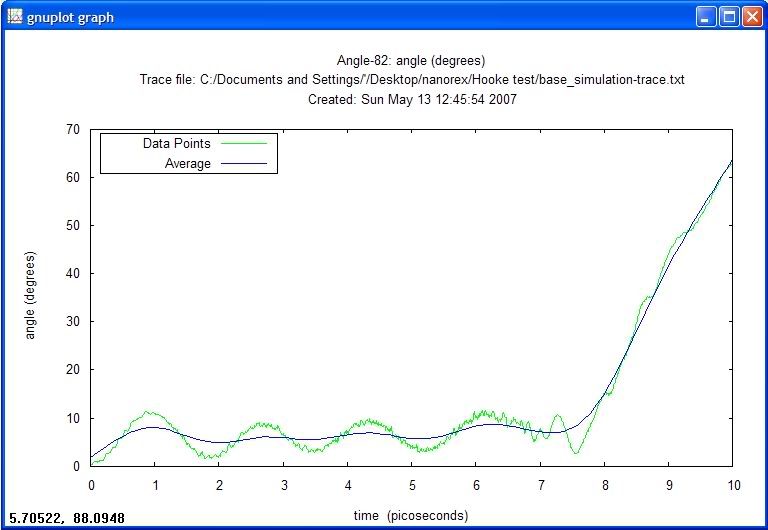
While the tube is 20A long, the actual distance from the anchored base to where the force is applied hovers around 18.5A. The tube makes a maximum deflection of 11.32 degrees before returning back to near equilibrium. However late in the simulation the tube slips to 11.52 degrees before becoming unstable and breaking apart. Here is the deflection/time plot:


These data points are also available in a text file, but there doesn't seem to be a way to export them to another application like Excel. I am ball-parking the average angle of deflection to be seven degrees, or 2.3 A. This gives a spring constant for the tube of 4.3 N/m.

A cursory search for similar experiments has not turned up anything, but I was able to find a company that sells carbon nanotube AFM probes with a spring constant of 2.8 N/m. If I can find a way to get the raw data out of NE1, or ever need to kill a couple hours by typing it into a spreadsheet, I will perform a more rigorous calculation.

I would like to thank Perry for providing the motivation for this post.

movement 114 rendered in nanotech -or- be careful what you wish for


Looks like someone didn't keep their fingers crossed, or maybe the torque and speed of the rotary motor was set too high at 150 nN-nM and 40Ghz. Also I have been thinking about placing the pinion in a bushing to try and hold it straight. Right now I am relying solely on the rotorary jig to position the pinion, and we all saw how well that worked with the first Pascaline attempt.

More to follow.

Friday, May 11, 2007

movement 114 version IV


What happened to version III? It didn't work. For version III, I built some low profile diamondoid teeth, but kept the sulfur atoms on the pinion to drive the rack. They just slipped past again, but it took another 43 hours to find that out. This is version IV. I doubled the height of the rack teeth and went with a conventional benzene-cnt pinion. Well, we will see how this design works out in a couple days. Keep your fingers crossed for the whole simulation time; I recommend tapping them together which is what I have done. It is likely in the next couple of days you will see scores of people walking around with their fingers tapped together in support, be sure to say hi.*


*I do not believe superstitions are any substitute for good design, but it can't hurt.