Wednesday, May 9, 2007

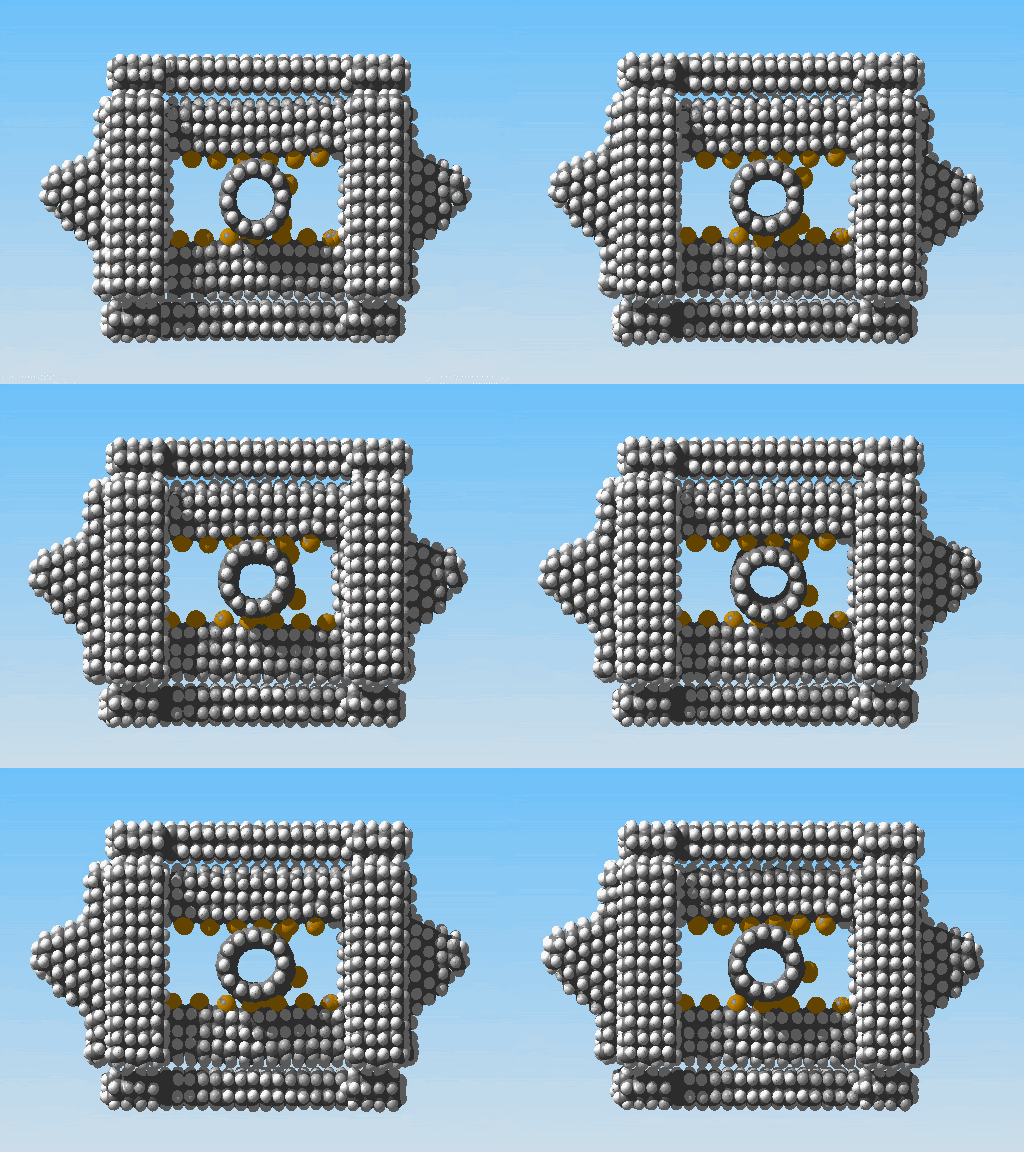
long simulation of movement 114


Here's the long simulation of movement 114. To put it frankly, the sulfur teeth just don't get any bite on the rack. It is impossible to tell from this straight on view, but there are two rows of sulfur atoms, one on each layer of adamantane. The sulfur atoms on the pinion gear just slip right through. This slippage, and my desire to build a completely diamondoid rack, has made me decide to scrap the sulfur teeth on the rack. I will rebuild them out of adamantane. However at least all the hydrogen atoms are staying put.

Also this piece has 5159 atoms. I set the simulation for 4000 frames with 100 steps per frame. I am simulating it on a Pentium 4, 3.0 GHz, with one-half gig of ram. This simulation took 32 hours and 31 minutes. This is just to give you an idea of how computationally intensive these projects are.

More to follow.

Monday, May 7, 2007

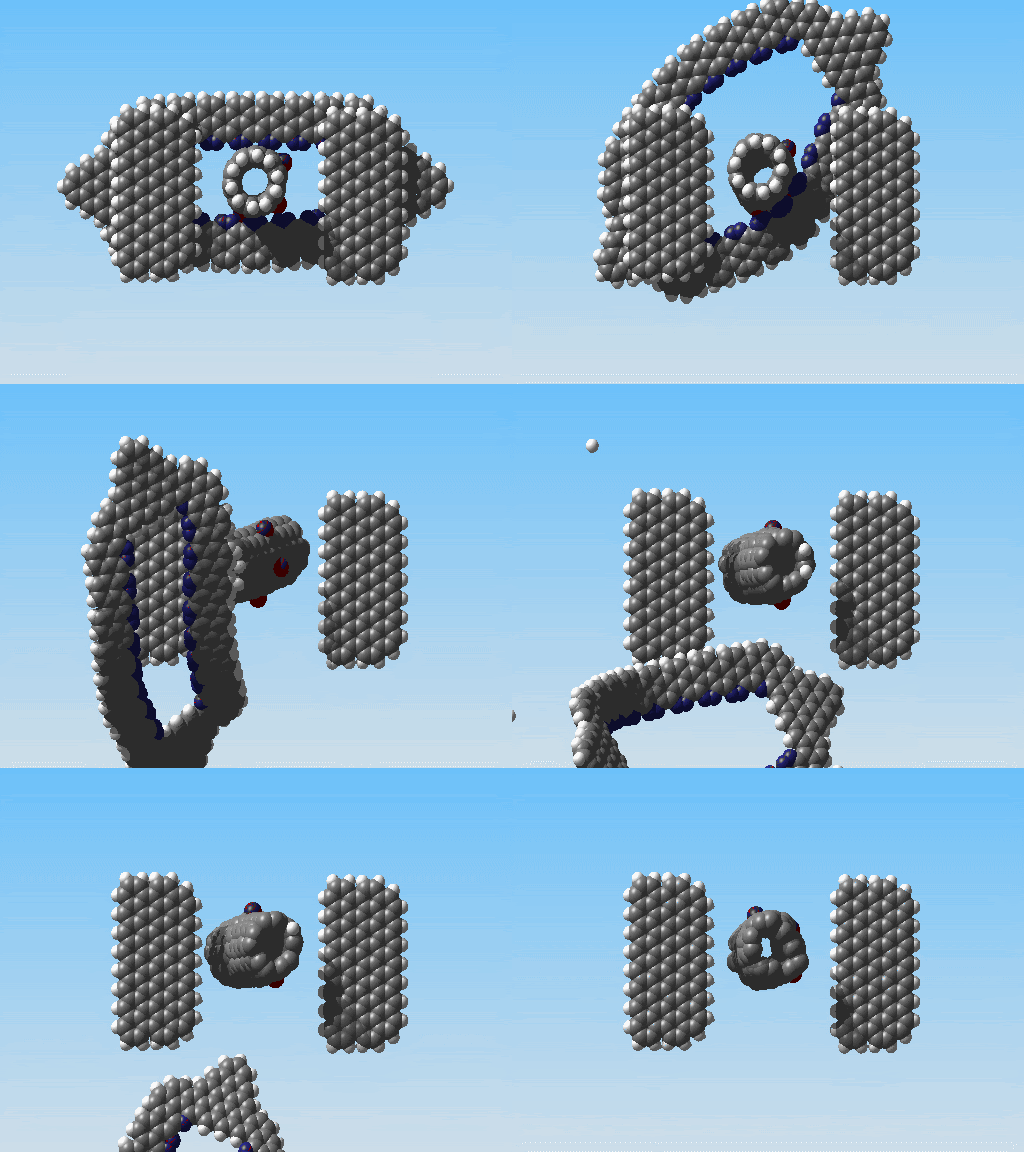
movement 114 rendered in nanotech -or- he huffed and he puffed but couldn't blow this house down


I stayed up to see how the new design worked. I appear to be getting closer. This clip is on the short side, didn't see the need for a really long one if the whole thing broke apart right away. I will make some adjustments where the plates ejected a few atoms and raise the torque on the pinion.

More to follow.

Sunday, May 6, 2007

movement 114 rendered in nanotech -or- she's a brick house


After some helpful advice from Perry Metzger, I present movement 114 version II. It is constructed out of Adamantane, a diamondoid. The rack is two layers thick and the alignment plates are one. The plates are not connected together, but held in place with anchor jigs. If it works with the anchor jigs, I will worry about building a single-piece casing. There are a lot more atoms involved in this version (I forgot to look how many exactly), so it is taking a lot longer to simulate. I will run one overnight, and then we can all watch it fall apart in the morning. <-that sounds rather grim. What I meant to say is I am sure everything will go just fine. However watching stuff break always gives you a good idea of where the weakest link is and just a part of the design process.

Also I am not too sure on the sulfur teeth (I got rid of the nitrogen and oxygen; sulfur has been good to me so far). I might end up having to make the entire rack out of diamondoid and go with a more conventional, and robust, "mutilated pinion".

Saturday, May 5, 2007

movement 114 rendered in nanotech -or- get out of town!

"Uniform circular motion into reciprocating linear motion, by means of a mutilated pinion, which drives alternately top and bottom rack."

Instead of brass I made my rack out of a graphene sheet, carved out to make two rows of linear teeth and end points. I capped the exposed inner carbon atoms with nitrogen. This was inspired by the nitrogen caps I used for the clutch plate on the simple nanotube clutch. For my "mutilated pinion" I inserted a pre-made carbon nanotube from the parts library. I transmuted six carbon atoms from sp2 to sp3 and place one oxygen sp3 atom across each carbon couplet to complete the pinion. To keep the rack aligned I placed four additional graphene plates with multiple anchors around their perimeter.

I guess some more alignment plates are needed? My favorite part is when after the rack flies off, all the hydrogen atoms go flying too; I can almost hear them go "Boing!"

more nanotube clutch and brushing up on my publishing skills


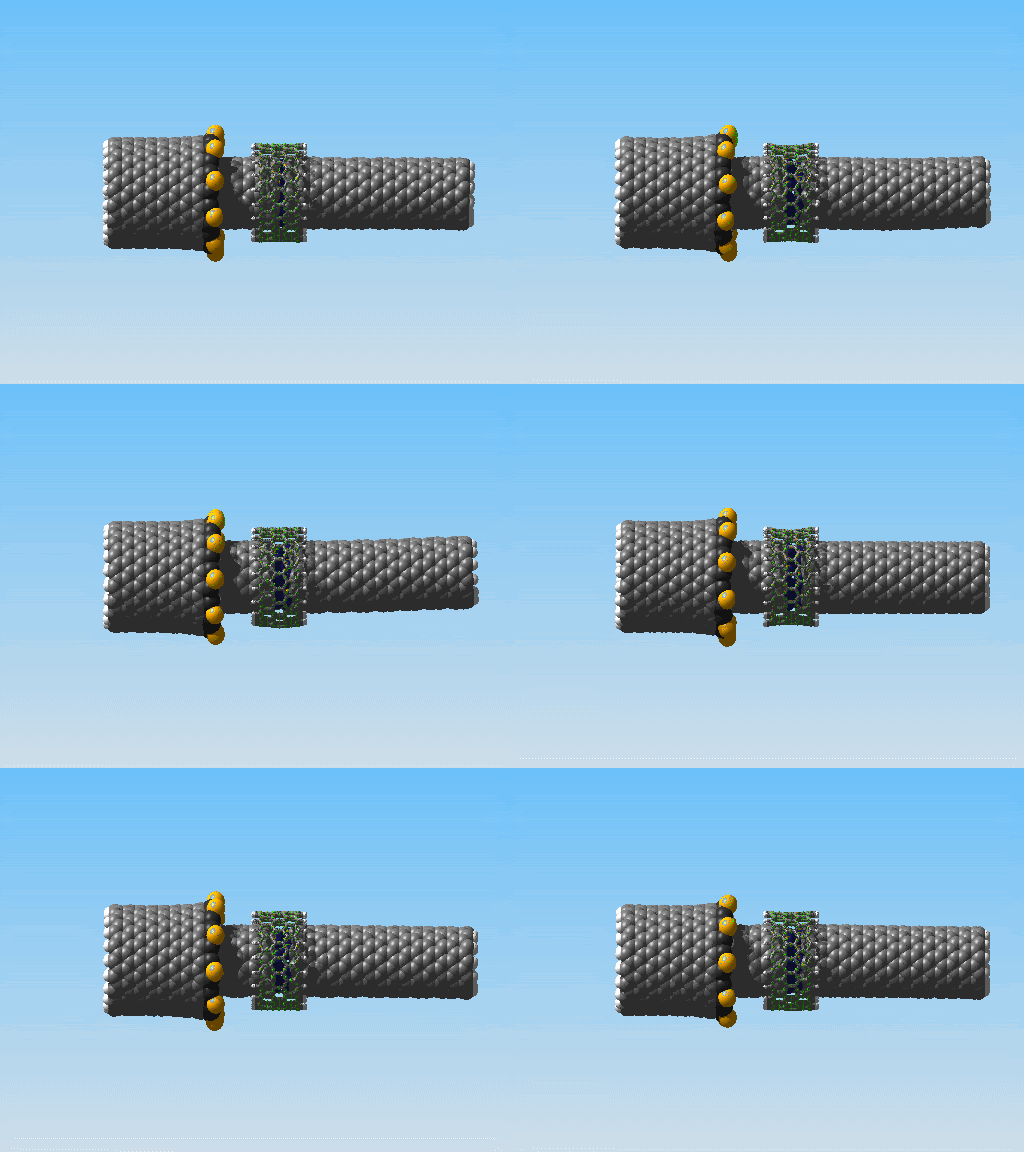
Here are a couple more of the simple nanotube clutch. The only change I made to the clutch system was to extend the secondary shaft. This was to give it more inertia and provide a stable base for the clutch shaft to press up against.

I am also tightening up the look of this place with click-free animation. Over the past couple years I've been collecting "mechanical movements". I have a drawer full of faded yellow reprints, penciled by draftsman who died long before any of us were born, depicting little mechanical systems from Victorian automatons and early industrial infrastructure. These can provide endless inspiration for nano-part design and generally are small enough to simulate on my computer in a reasonable amount of time.


Here you can see there is a lot of slippage between the clutch shaft and the primary shaft. This should not be a big deal. I am confident that I just need to line up the two rows of hydrogen atoms a little better.

Thursday, May 3, 2007

simple nanotube clutch


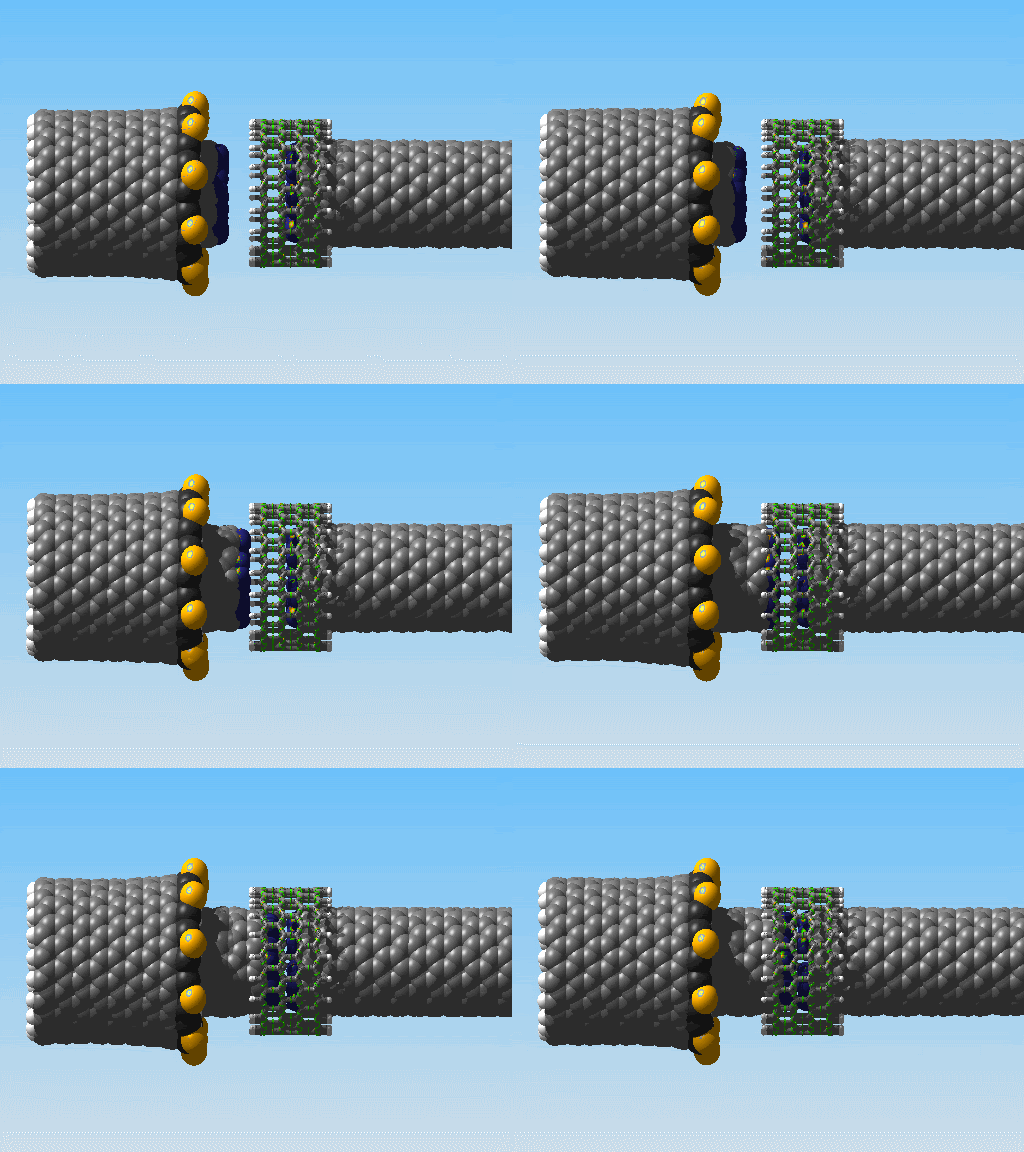
These are actually animated gifs, but they are not showing up as animated in my browser. I don't know why. If they are not animated in your browser too, and you would like to see them animated I would be happy to send the gif file to you. This is another simple clutch design I have been working on. The movie is pretty short because I can only run the simulation until the clutch shaft (small shaft on the left) actually engages the secondary shaft (small shaft on the right). This limit comes back to not being able to set the travel of the linear motor. Here's another view with the bushing hidden:


In this design I am using nitrogen atoms (blue) to cap the carbon nanotubes. This forms the clutch plate. The primary shaft (largest) has a row of hydrogen atoms around the inside circumference. The clutch shaft also has a row hydrogen atoms on the outside circumference on the end inserted in the primary. My hope is as the clutch slides forward the two rows of hydrogen atoms engage. However I am not sure when I will be able to test the entire system, not until after the linear jig has some more control. Until then I will try to test it out piece wise.

Feel free to contact me for the gif files or for any other reason:

mooreth42@netscape.net

Wednesday, May 2, 2007

nanotube Pascaline - making progress


Between looking around for employment opportunities (ahem ahem) I have had some time to get back to work on my nanotube calculator ambitions. I am still working on developing techniques to build the little systems I know I'll need to build anything resembling a functional computer. The picture is another experiment to demonstrate how to connect three (or more) nanotube shafts of different diameters. This will be extremely valuable for efficiently transferring torques and changing speeds. As usual the small gear is the drive gear, but the heart of the experiment is the thickish looking ring of atoms extending out from the large tube. This is the start of, what I hope will be, a clutch mechanism. The final design should allow me to connect nanotubes of different diameters and start and stop their rotation using a linear motor jig. However, just like with the rotary motor jig, the linear motor jig can not be programmed for a certain amount of travel per direction, at least I don't think it can. I am thinking I may have to add that feature (as I look dishearteningly at the programming textbooks on my shelf). Well, let's just say someone needs to add stepper functionality to the jigs.

But some might ask: "Tom, if this was a real nanotube computer, who would you get to pull the levers to engage it all, Maxwell's demon?"

I bet we would have a good chuckle at their witticism. After everyone had composed themselves I would casually throw out "DNA springs"; game-set-match.

More to follow